 Menu
Menu
MEDITATIONS ON WRITING
Latest meditations | Random meditation
Wed 21st Aug 2024
Introduction
This is me in dialogue with myself. Learning and unlearning how to write over the years – heeding some advice, ignoring others, and carving out something new for myself, something that feels right. Any craft can be developed to a point where you transcend how you’re "meant" to do things, and you have the confidence to do what comes naturally.
I cannot teach you how to write. I can only tell you how I write.
Some of these thoughts may seem to contradict one another, but it all depends upon the specific book you’re writing, and the context. Some of it I might even disagree with, depending upon the book, or what mood I’m in. Nothing is set in stone.
The grammar won’t be perfect – these are rambles, notes, emails. Often I’ll repeat myself. Sometimes it’ll be nonsense. In truth, I never thought anyone would see them. Take what you can – discard the rest.
These are my meditations.
Ben – 21-08-2024
1
Thu 11th Jan 2024
So you’re writing a novel?
You tend to be in constant danger of coming up with a good idea, and then writing that idea in the most straightforward direct one-dimensional way, rather than thinking about what truly makes good literature.
True art can’t be faked. It has to come from passion, from love, from something to say.
My main advice is:
- Think clearly, by walking, fasting, drinking water, writing notes
- Great literature is about particularities and people
- Don’t write a plot, allow your characters’ lives to unfold organically
- Read great books
- Don’t overthink it
- Do other things that aren’t writing, but try to write at least a couple of times a week, and don’t beat yourself up
- Enjoy it, even the hard times
2
Fri 17th Oct 2025
To any beginner writers who might be reading this...
Most of my meditations here are useless until you first understand the art of storytelling. Most of these meditations are the icing on the cake, the rules to break when you understand the rules.
Here are some brief points that helped me at the beginning. Every character should want something, and feel deeply conflicted because they can’t get it. The thing they want is usually linked to some inner flaw or weakness they must overcome. Almost everything in the story should be informed by this – that is the story. For a compelling novel, every scene should propel the next one like a series of dominoes, as if each scene is saying ‘and’, ‘but’, ‘therefore’, rather than a series of disconnected events. Start the story as late as possible, finish as early as possible. Think about your 25%, 50% and 75% points. When the characters speak, don’t let them say exactly what they’re thinking. Be particular in your details. Use contrast. Find your theme and embellish your story with it. Remember that rules can be broken, but they exist because they work.
There are hundreds of invaluable books and resources about storytelling – characters, plot, structure, and so on. I urge you to seek out as many as possible. Use what works, discard the rest. I’m rooting for you.
When you’re ready, see me again. I might have some thoughts that’ll help.
But believe me when I say, you’re never done learning.
3
Wed 27th Nov 2024
How to write a novel – note to my future self.
These steps are more about the process and mindset than the craft.
1. Come up with an idea you’re passionate about. This will usually be based on a deep feeling and a theme you care about, combined with some kind of human struggle. It helps to have a main character who loves to do a particular thing, so that you, the writer, can absorb yourself in that space. I like characters that allow my mind and my words to wander – someone who pays intense attention to the details of the world, and whose mind doesn’t necessarily work the same as other people’s.
2. Make clear in your gut what this book is. What it feels like. Imagine it already exists somewhere in the ether, and you’re just extracting it. You don’t know everything that happens, but you know how it feels, and you’re trying to recreate that. Write splurges about what this book feels like, as if it’s already a classic. What imagery sums up this novel? What are the sights, the sounds, the set-pieces? And don’t be afraid to research! So much of your motivation and inspiration comes from learning about specific things and exploring them in your own way.
3. Start writing the book. Write as much as possible without reading any of it. Aim to write at least 60-70% of the novel. Write with your critical mind switched off – the critical mind will only try to stop you. Don’t overthink it. Don’t worry about "plot" – you’re writing something more than that, something that will emerge as the sum of its parts. Be specific and particular. Don’t try to be clever. Write from the truest and deepest part of yourself. Get comfortable and relaxed, and just write, trying to capture this idea. If you get stuck early on, you’re writing the wrong thing. Write what excites you. Experiment. Play. Write loosely, freely, simply, with as much rhythm and flow and beauty as possible. Allow yourself to not write a masterpiece, otherwise you won’t write anything at all. The next one can be a masterpiece.
4. When you’ve written as much as you can, you’ll get stuck. Now is the time to start reading what you’ve written. Only then can you know what’s left to write. You might think you’ve written enough of a certain aspect of the book, only to realise there’s lots more to add. You might find that the book needs to be longer or shorter than you thought. Don’t get discouraged. If you followed step 3 correctly, most of what you’ve written should be good.
5. Write the remainder of the book. Then read it through, tightening, deleting, shuffling and adding, until the book has become what it is meant to be.
4
Sat 6th Jan 2024
Can’t think of an idea?
- Think of things you care about and find interesting, like death, family and art
- Think of what kind of character would allow you to write stream of consciousness prose poetry
- Think of what you could draw deep emotion from
- Think of ways that modern life could feel epic and poetic, even in subtle ways. A journey. A train, a library. A boat.
- Think of a strong hook to tie it all together, to make it easy to pitch. Something where you immediately get it, maybe related to something people already understand
- Update 08/07/2025 – research!
5
Tue 30th Jul 2024
I think ‘theme’ is more important to me than I’ve given it credit for. It’s the magic that holds the opera together.
6
Tue 8th Jul 2025
Research
I’ve reluctantly realised that research is essential to my process.
I never think it is. I like to think I pluck everything straight from my head. If I research things, it’s incidental.
But research helps me get started. It helps me get excited. It gives me something to think about, and things to say.
Even if I don’t directly use what I’ve researched, it can trigger things in my head, it can spark ideas. It is fuel. I’ve already used up my previous ideas in previous novels, so I need more.
I tend to write very freely, with a loose plot. Research gives me a direction. It gives me beacons. It keeps me engaged. I can take what I’ve learnt and make it my own.
It was essential for the one about death, even though I didn’t use much of what I’d learnt – I’d been subconsciously researching that one all my life.
It was absolutely vital for the one about the mountain. Again, I like to forget that. But almost every scene involved some reading or videos.
And it’ll be crucial for this new one, this blue one.
Especially at the beginning. But also, any time I get stuck.
Without research, my head is quiet.
7
Fri 22nd Sep 2023
How to write good prose: nodes of specific interest in frequent beats.
8
Mon 1st Jul 2024
I like to write novels like I’m writing a song. In a song, every line matters – but more importantly the lines aren’t there to convey information.
So much writing these days conveys information. About people, about their actions. But in a song, the lines are there to be felt. They exist for the sake of themselves. If they convey information at the same time, great.
I’m not saying the sentences should be nonsense. They can (and usually should) make perfect sense. But rather than being informative they are expressive, allowing a place or a person or an idea to unfold, to be explored.
Yes, a lot of the lines in my novels convey information. You could even say that all communication conveys information in some sense. But when we hear a song, the words are doing something different. Something deeper. The language itself has value. The sentences aren’t a tool, they aren’t explaining. A lot of the time they’re not even describing. They are just a direct expression of a thought about the world – inward or outward.
This isn’t "show don’t tell". Don’t show me anything. Let me see it for myself.
9
Thu 11th Jan 2024
Some of the best stuff you’ve ever written is when you switch off your brain, and all you have in your mind is the character(s) and their situation, and you just write from their point of view, internally, stream of consciousness, capturing a feeling.
10
Thu 2nd May 2024
Write something…
- deeply human
- deeply emotional
- deeply personal (needs to be something I care about, even if I’ve written about it before)
- poetic
- beautiful and specific
- stream of consciousness (in places)
- with something to say (a philosophical dilemma to be explored)
- possibly with some kind of downward mental spiral
I want every novel I write to have these elements.
Sometimes I come up with ideas and I forget those first 3 bullet points.
11
Sun 12th May 2024
Give yourself permission to write shit.
12
Fri 7th Mar 2025
The first step, for me, is to be able to imagine that this incredible novel exists. I need to be able to feel it. I need to be able to imagine it’s done – it’s written, it’s great. It’s bound, it’s published, and I’m very happy with it. Only then can I work towards creating this imaginary novel. Without this Great Imaginary Novel, I don’t know what I’m working towards.
13
Fri 23rd May 2025
The feeling
I start with a feeling.
A very specific feeling of what it would feel like to read this book.
I don’t know everything that happens yet, but I know how it feels – maybe this book feels bittersweet and epic and intimate and dreamy and visceral. Maybe it leaves you with a sense of awe, or gratitude. Every book is different. Most likely it’s a complex mixture of many of these kinds of emotions, adding up to a sensation that’s impossible to describe, which is why the book must be written.
Before I start writing the book, I want to be overcome with this feeling. I want it to swell in my heart – I want to nurture it, I want to grow utterly familiar with it over the course of weeks or months. I want it to feel incredible, and ready to burst out of me.
Importantly, this isn’t just a description of a feeling – it’s a very specific and real sensation in my gut – the same sensation I’d feel after reading the book.
The feeling is king. After all, what is a piece of art if it doesn’t make you feel anything?
Now my job is to capture that feeling.
Usually I’ll need a premise, some kind of framing, maybe a handful of ideas for scenes.
But every time I sit down to write, my mission is simply to capture that feeling. If it captures the feeling, I’m moving closer to the finished book. If not, I’m moving away.
I’ve written enough books that I usually know how to capture the feeling – it’s rare that I’ll write anything that takes away. Still, the simple test throughout the writing process is – does this enhance the feeling or dilute it?
Along the way, we’ll inevitably have characters and events. But I can’t start with these and just hope they’ll produce the feeling. I am not creating them for their own sake, I am creating them because they serve the feeling.
This might seem backwards, but what we’re left with, of course, is the feeling. It doesn’t matter how we got there.
After reading the finished book, we could bask in the glow of this feeling, and we could ask, how did he make me feel like this? How did he know that those characters and events would add up to this feeling inside me?
The answer, once more:
I start with a feeling.
If I don’t have that, I don’t have a book.
---------
Update: If ever I write a book about writing, this would be a good place to start.
14
Sat 6th Jan 2024
It’s about people.
Have whatever hook you want (preferably something instantly relatable, intriguing and easy to pitch), but do NOT lose sight of the human element.
The greatest stories are about PEOPLE. Who are these characters? And not just the main character, but the other characters playing off the main character, contributing to the theme in different ways.
How are these characters going to help you capture that feeling?
15
Sun 12th Feb 2023
Be honest and specific.
Read that again.
16
Wed 30th Jul 2025
Story structure distilled:
Show the status quo, and promptly shake it up. Have something earth-shattering happen in the middle and near the end.
That’s it.
17
Wed 21st Jun 2023
A lot of good fiction is about being specific and slightly unusual. Little details and quirks that you haven’t heard elsewhere. It’s not that they’re wild or outlandish, they’re just so specific, like no one’s ever noticed it or captured it before. But you will notice them because you’re a good writer. Little character traits – little habits and mannerisms. Body movements, hand movements, facial movements, the way they interact with the world, the way they speak. Descriptions of the surroundings – again – with very specific little details. This is what brings fiction to life and makes it feel real and original.
18
Tue 19th Sep 2023
I’m sure I’ve probably said this in a hundred ways, but so much of the soul and colour and life of fiction comes from being specific. Specific little details, quirks, nuances – unusual but not crazy, like you’re shining a light on something that people might otherwise miss. Or you’re showing a nuanced thing, but it’s not wild or unbelievable, it’s just so specific, so distinct, so idiosyncratic, and this makes it seem more real.
Characters with weird habits, weird hobbies, weird likes and dislikes, who are in a specific life situation, who have an unusual physical quirk. Locations and situations and descriptions with little details that only a good writer would notice.
I think I’ve finally summed it up:
It’s so specific it makes you ask, "how would a writer even come up with that unless it was taken from real life?"
You mustn’t forget this. It needs to be front of mind. This is when the true magic comes out.
19
Fri 14th Jun 2024
Beacons of Particularity
The word I’ve been trying to summon for months is "particular".
Good fiction is about being specific, but there’s no point in being specific about something we’re all familiar with. If a man enters a hotel room in a very normal way, we don’t need to know specifically how he did it.
We need to be particular with our details.
Not unique, necessarily. Not even extraordinary.
Just utterly particular to that character or place or thing. Their actions, their words, their quirks.
The man steps into the hotel room and pushes his bed to the window. This is particular. What does it mean? Perhaps he doesn’t like to feel caged-in. Perhaps he’s a controlling person – adapting his surroundings to suit him. Whatever the answer, it’s more particular than pouring himself a glass of water. It’s not unbelievable. In many ways it’s mundane. But it’s particular to that character – it shows us something without telling, it raises a question that may or may not have an answer. And it creates a kind of glow in the reader’s mind – an interesting little beacon.
You can feel when a book (or a film or piece of music) is lacking these beacons. No matter how riveting the story appears on paper – even if your characters have deep desires and hurts – even if you do everything else right – without these beacons of particularity the overall effect will be dull, flat and empty.
On the flipside, you could do everything else "wrong", but if you have these beacons, I believe you’ll have something worthwhile. The description and characters and dialogue will have no choice but to be interesting for their particularities alone.
Look out for them. These particularities. In books, in films, in life.
And don’t overdo it. They are beacons, not forest fires. We don’t want to blind the reader with details. Do it with intent. Often the man can just enter the hotel room. Often he can just pour a glass of water. Often we don’t need to see either of these things. But if you scatter enough beacons along the way, the book will glow.
20
Thu 4th Jul 2024
Don’t just write your sentences. Deliver them.
Don’t just use sentences as a means to an end – "he said, she said, action, description, action, description" – explaining the story as though you’re dictating a film, beat for beat.
No, you’re writing. So use the language. String your sentences together in a way that’s quotable. String your sentences together in a way that someone might sit down and learn because it’s so rhythmic and precise. String your sentences together in a way that someone might want inscribed on their headstone.
I’m not saying your language should be unnatural or obscure or overwritten. I’m not saying you should use fancy words. But it doesn’t need to be plain. It can be clear and beautiful. Concise and striking. Simple and poetic.
It’s all poetry, even when it’s prose. This isn’t a screenplay. It’s not a police report. It’s not an encyclopedia. Treat it with the respect of a poem.
Carefully-chosen words with a pleasing rhythm and structure.
21
Mon 24th Jun 2024
People say, write your first draft fast. Don’t overthink it. Get messy. You can’t edit a blank page.
But I would add, write ONE scene that you love. One scene (preferably the first) that shows off what this book is. How it feels. Spend some time on it. Get it right. Because while you’re wading through the mire of the first draft you made, this scene will be your North Star. It’ll keep you on track. It’ll remind you what this book is meant to be. It’ll show you that you are a good writer, and that this thing is possible. It’ll guide you to the end.
22
Tue 1st Aug 2023
Try to imagine there’s this amazing book that people are talking about, especially in the literary community.
What’s it about? How does it feel?
Write that.
23
Tue 4th Apr 2023
Treat each character as though they’re subtly mentally ill, as though some of their quirks are alien to us, and yet perfectly believable, often relatable. Ask yourself why they do these specific things.
These are the ingredients of great fiction.
24
Tue 9th May 2023
Do you go deep enough into the characters? Simple, real life moments. Specific, beautiful, believable. Not just a plot, but as though this is a real world. After reading To Kill A Mockingbird, it’s SO character-focused it almost puts your writing to shame. Bits of weaved-in backstory, events that aren’t the plot, people saying things that aren’t strictly plot. An exploration of a life. It feels real.
25
Mon 20th Nov 2023
If you’re struggling for what to write, ask yourself how each of the characters is feeling.
You might think you already know, but keep probing it.
26
Thu 11th Jan 2024
Don’t forget to describe how the main character feels physically.
27
Thu 11th Jan 2024
You know you need to add tiny specific character moments. But add them in such a way that it’s not obvious what they mean on the surface – it’s a mask, a metaphor for how they’re feeling. Make them do small and unusual things that hint at what’s really going on beneath the surface.
28
Fri 19th May 2023
When you analyse fiction, you have a habit of analysing the words. The description, the poetry, the rhythm, the images.
You hardly ever analyse the way the characters behave. The things they say, what they do, the decisions they make, the things they think and feel.
This is something you need to get better at in your own writing
I think over the years, thanks to school, you’ve focused too much on writing techniques, and not enough on the FEELING the CHARACTERS provoke in the reader.
If you had to use ZERO poetic techniques, if you stripped it all away, how would you get the characters to make the reader feel something? What would they say and do?
29
Tue 21st Mar 2023
It sounds obvious, but make sure the main characters have distinct interesting personalities.
30
Thu 15th Jun 2023
I think a good side-character will SURPRISE the main character.
31
Sat 6th Jan 2024
I think one key to creating a complex character is to have parts of their personality on the surface that contradict parts of their personality below the surface.
32
Tue 21st Mar 2023
Push your character to the darkest depths of what it means to be human, with pain and raw emotion. How? What are the events? When you imagine the best possible version of the book, what happens?
33
Fri 22nd Sep 2023
If there’s something the main characters want (which there should be), make sure they REALLY want it, and it’s heavily contrasted with not being able to get it.
34
Tue 4th Jun 2024
Replace the shit words with good words. It’s as simple as that.
35
Mon 20th Nov 2023
Start with something that ISN’T the point of the scene. The characters just doing something, somewhere.
36
Thu 5th Oct 2023
Don’t write a scene, write ANYTHING that you feel will contribute to the book. Snapshots and atmosphere.
[Later addition:]
But it doesn’t always start like that. With the death novel, you started with a list of scenes, and wrote them.
You wrote a big description about the characters, who they are, what they do, their interests, what they want, their flaws, and what you want a reader to see. "I want to show", "We need to see", "I want the reader to feel"...
You had a huge document, called "lots of scenes to write".
37
Thu 5th Oct 2023
Don’t think of scenes that progress the story. Think of scenes that contribute to this overall picture you’re painting.
38
Wed 11th Oct 2023
Go wild. Unleash yourself. Nothing has to be written in the straightforward obvious way that it first seems it should be written. Have fun. Experiment. Be confident. Play.
Show the reader how free you are.
39
Sat 1st Apr 2023
What would a reader want to see more of? What are they owed?
Update: what are they not owed?
40
Sat 13th May 2023
Don’t tell a story. Allow a story to be told.
41
Mon 20th Nov 2023
Instead of writing the plot, let the characters show you what they want to do.
Let them live in your head.
42
Fri 12th May 2023
Write characters and moments that DISTRACT from the plot, but in a way that is thematic, builds tone, fleshes out the world and the people. In a way, this is more plot than the plot. The plot only needs to be a backbone holding it together. Even four or five major events is enough. The rest is the real literary meat.
43
Sat 6th May 2023
One of the most interesting modes in fiction isn’t when the character is explaining how they feel, but when they’re explaining something about themselves, or the world, or their current situation, in a way that is visual, full of metaphor, speculative, philosophical, full of interesting not-obvious human truths.
44
Wed 3rd May 2023
Always ask yourself, what is the point of this scene? BUT! (And here’s what I forget sometimes), then ask yourself, what’s something that’s happening in this scene that ISN’T the point of this scene, and start with that.
Add layers. Every scene has a point, but it can’t only be the point. Layer it with things that aren’t the point.
45
Tue 11th Apr 2023
Don’t be afraid to come up with new characters that don’t directly tell the story.
46
Tue 21st Mar 2023
Don’t forget inner musings and meditations. Think of things you
actually want to say, and weave them into a beautiful, emotional
narrative.
Update: But don’t preach. Say it without saying it.
47
Tue 21st Mar 2023
It sounds obvious, but worth a reminder. Make sure the book has emotion, internal hardships, challenges, struggles, and conflict.
48
Tue 21st Mar 2023
Don’t forget to have incidental meetings, happenings, moments that aren’t directly related to the plot, so it feels organic and real. An outline is just bullet points – don’t be afraid to explore and let the characters do what they want.
49
Fri 28th Jun 2024
The subtext is what readers talk about. There’s little point in talking about the text – it’s the text – it’s there, it speaks for itself. But the subtext is what needs unpacking. What does it all mean, really?
50
Tue 25th Apr 2023
Sometimes you have to do things that are COUNTER to the plot, even though you’ll eventually just be doing the plot. This makes it less predictable and less linear.
For example, let’s say a person has to go to a place. Make them NOT go to it first. Show who they are. Let them fight against it. Maybe they’re too scared, or bitter, or having too much fun where they currently are. Maybe they believe they have to go somewhere else.
Whatever the case, this is a great opportunity to reveal character by showing the alternative. The easy route. The route where they haven’t learnt certain lessons yet.
51
Tue 4th Apr 2023
Write events, characters, encounters that aren’t "strictly" the story, but allow the story to unfold. This is more natural, interesting, and character-revealing. Otherwise what you have is plot, and it’s straightforward and ugly.
52
Thu 23rd Mar 2023
A story should never be ABOUT the plot. People talking about "the thing they have to do", and then they try to do the thing, and they are met with opposition, so they try again. A good story is about people. Always. The plot is the setting, the circumstance, the WAY we’ll demonstrate who these characters are. The plot only describes the events of the story. Not the other way around.
53
Sat 9th Sep 2023
The death novel feels very different to everything you’ve written. It feels better. You’ve always known that good literature is about PEOPLE but never really lived up to that.
You need to have people living their lives, doing real things, and the "plot" is the few bullet points along the way, such as someone dying.
In most of your books, every scene is a bullet point scene. You’ve tried so hard to have no needless stuff in there, every scene is a part of the story with no breathing room to explore who these characters truly are. It’s almost as if the art novel needs to be twice as long, with a new "nothing" scene between every scene currently there.
With the death novel, there is very little plot so you’re FORCED to make it beautiful and interesting through the characters alone.
54
Fri 15th Sep 2023
With many of my past books, my thought process was "here’s what needs to HAPPEN in this scene".
But with the death novel, it’s much more "here’s what I need to SHOW in this scene" – for example, show the character being a midwife. Show a man whose sons don’t want to take over his business.
It feels a lot better, more organic, more literary, to write that way. Not thinking about events, but about situations, portraits, atmosphere, life.
55
Mon 20th Nov 2023
Don’t forget scenes of SPECIFIC NOTHINGS – not everything is an event. You can think of very specific things for your characters to do together that aren’t plot, they just reveal character. Just write what you FEEL it needs – organic, real.
56
Mon 20th Nov 2023
Reminder: Things don’t have to be over in one scene.
57
Tue 2nd Jan 2024
I seem to be able to describe stuff, like a car crash, or wandering, or someone ‘being lonely’.
But when it comes to 2 or more people interacting, whether it’s first-person, or third-person, I seem to fall into a trap of dialogue > beat > dialogue > beat, until the end of the scene.
If I can do that first part (describing stuff), but struggle with the second part (interactions), why not start every scene by writing the description, making it interesting in its own right, and then weaving in the dialogue?
58
Mon 2nd Oct 2023
Make it a sensory experience. Epic and intimate, the natural world, loneliness, emptiness, wandering, beauty.
Not a plot. Exploration. Different views. A toy box of scenes. A painting. Moments. Poetry.
Don’t push the characters along. Let the reader experience their lives.
59
Thu 11th Jan 2024
I think there are two kinds of stories. Bridges and paintings.
Bridges take you from A to B in the most entertaining way possible. They can be funny, scary, romantic, anything – they don’t even have to be linear – but always they carry you forward. Bridges are good.
Paintings also tell a story, but they can be studied piece by piece, and usually the true meaning comes from within. It often involves seeing the painting as a whole. A painting can be interpreted. They can be nebulous, with no real path – just layers of beauty and emotion guiding you. Paintings are also good.
(These ‘paintings’ are often called literary fiction, though that’s not strictly what I mean. I think literary fiction can sometimes be a bridge, and genre fiction can be a painting.)
I like paintings the most. I like reading them, I like writing them.
My problem, I’ve realised, is I try to turn my paintings into bridges. I’ll have a gorgeous idea for a painting, and I’ll start painting it, and it’s going well, but by the end I’ve welded it all together in a way that isn’t true to myself, because I’m trying to create what I think people want. I’ve made a bridge.
I need to stop doing that.
I’m not a bridge-builder.
I’m a painter.
60
Sun 17th Sep 2023
Instead of:
"in this scene, X needs to happen"
use this:
"in this scene, this is how things are, and here is how it unfolds"
61
Thu 18th May 2023
- Action
- Description
- Dialogue
- Exposition
- Inner monologue
- Analysis of the situation (without killing it)
- Philosophy
- Physical sensations
- Description of self (longterm, immediate, tangible and intangible)
- Weaved-in backstory
- Moments that aren’t plot
62
Wed 11th May 2022
Show, don’t tell? How about play, don’t show?
No one likes to just be shown something – ‘there you go, have a look at that’. The reader wants to be involved, filling in some of the blanks. Meeting you halfway. Figuring things out. Forming their own opinions.
So lavish them with beauty and excitement, but tease them with meaning. Present unfinished arguments. Never show them the one truth.
63
Thu 24th Mar 2022
Keep those scenes that aren’t essential to the plot. Delete the scenes that take away from the tone.
64
Tue 24th May 2022
What you need to do is tell the whole story, without any shit scenes. You know those scenes where you’re just telling the story. It’s just people saying what they need to say, and doing what they need to do – the most direct route through the story, without any layers or subtext. Tell the story through other stories.
65
Fri 26th May 2023
Show, don’t tell?
Some of the best stuff you write is telling. Talking about something, or a little piece of backstory about a character, or giving some context.
Your writing feels most empty when you’re literally just describing a place, with some character actions and some dialogue. "She does this. She looks at me. We go outside." In scenes like this, it’s actually way more interesting if you intersperse it by telling us something, weaving it organically.
"Telling" helps to give details. It broadens the feel of a piece.
Here are some ‘telling’ ideas, based on the art novel.
- this character spends his days doing X
- she once told me that Y
- I used to believe Z
- my mother was...
- if only things were more like X
- i don’t know whether...
- this is how things are...
- how can this be?
- this is the kind of person who...
- Maybe things would be different if...
- [noun] is [adjective], and here’s why...
- here’s a description of a person or a place, but also here’s why it’s like that, or what it means, and why it’s interesting, and how it affects me...
- here’s a hypothetical way things could be, and what it would mean...
- what if things were like X?
- here’s what this situation/person/thing means to me, without describing an emotion...
- i’d be better off if...
- maybe things are the way they are because...
- why do i do this?
- maybe i should...
- i consider doing X...
- i never thought about...
- how can i...?
- although things are like this, they’re also like this...
- i like this because...
- i hate this because...
- here’s a theory...
- i cannot and will not do this, because...
- this was never meant to happen...
- when things are like this, i tend to...
- this is the way things seem to me...
- it’s funny, when you think about it...
- people like me are...
- It’s as if...
- I haven’t done X since...
- what does X actually mean?
- I wonder...
- I wish...
- I have no idea if...
- I try to imagine that...
- I’m expecting X, but Y happens...
- I’ve forgotten...
- I feel [physical sensation] because...
- I see a [random thing], and it makes me think...
- I’m reminded of...
- This is how things will be now...
- I know for a fact that...
- Here’s what i’m going to do, because...
- Nothing is more effective at X than Y...
- I try to do X, but Y...
- There’s something currently happening, and here’s what i think of it...
- could I do X?
- i don’t care about X because...
- this is fine, because…
66
Mon 22nd Jul 2024
Dialogue, for me, is where stories can start to break down. If you’re not careful, dialogue can expose the plot like the man behind the curtain, because the characters say how they feel, what they want, and what they wish were different. This is gross.
There are a few ways around it:
- Make your characters skirt around the issue
- Make them hide what they really mean
- Never let them say how they feel
There are 2 issues with these.
Problem 1 – in real life, people often do say what they really mean, and state what they want. A novel isn’t real life, but this still doesn’t sit right with me.
Problem 2 – dialogue is the only part of a book where we ask the reader to perform. Our readers have to say what our characters are saying. So unless the reader is an accomplished actor, they’re in danger of playing the scene in their head like a Saturday afternoon B-movie. Your carefully-crafted words are being read as if from a script for the first time. (Because that’s almost literally what’s happening).
This might be an unpopular opinion, but sometimes I find it’s best just to tell the reader what the characters spoke about rather than showing each line of dialogue.
Instead of having some icky back-and-forth between two divorcing parents, where they say how they feel, or they mask their feelings and skirt around the issue – all of which is interjected by sips of tea and glancing out of the window – instead of the characters melodramatically shouting the plot at us – why not narrate something like: ‘We spoke about the day we got married. We spoke about Billy, and which one of us would take custody if I left.’
To me, this is far more elegant. Yes, it’s "telling", and we’re urged as writers to "show not tell". But to me, this leaves it to the imagination. Instead of being shown exactly what was said, line for line, we’re forced to consider how that conversation might’ve unfolded based on our knowledge of the characters. This can feel much more real. It’s like one of those scenes in a film where the voices fade, the music swells, and we watch the characters speak, argue, fight, without needing to know exactly what was said. We don’t always need it.
Sometimes we do. Sometimes – most of the time, in fact – it’s definitely worth showing us exactly what the characters are saying. Or maybe start by showing, and end with telling, or vice versa. But when we get to the real on-the-nose meaning of the conversation - the whole point of the dialogue – try just telling it.
Because the truth is, in real life, people say stupid, boring, obvious things. We don’t want our novel to be stupid, boring, or obvious. We can try to circumvent this with clever misdirection and subtext. But with a few well-chosen lines of telling, we’ll know enough, and fill in the rest with pieces of ourselves.
67
Thu 9th May 2024
Some words carry more weight than others – you can almost feel it – you can glance your eyes across a page and see it.
And I think the real magic is the nouns.
Specific nouns – not tree, but willow.
Not dog, but chihuahua.
And when you see lots of these on a page, it comes to life.
Of course the nouns need to be well-chosen, they need to flow, they need to exist for a reason, they have to carry emotional weight.
But the nouns do a lot of the work.
68
Mon 22nd Jul 2024
Be observant.
69
Mon 22nd Jul 2024
Only write the most important scenes once you know your characters inside and out. This will usually mean waiting until you’ve written everything else.
70
Tue 30th Jul 2024
Write what you’d need to write for people to say "he completely raised the medium to new levels".
Sounds ridiculous? Why?
71
Wed 3rd Jul 2024
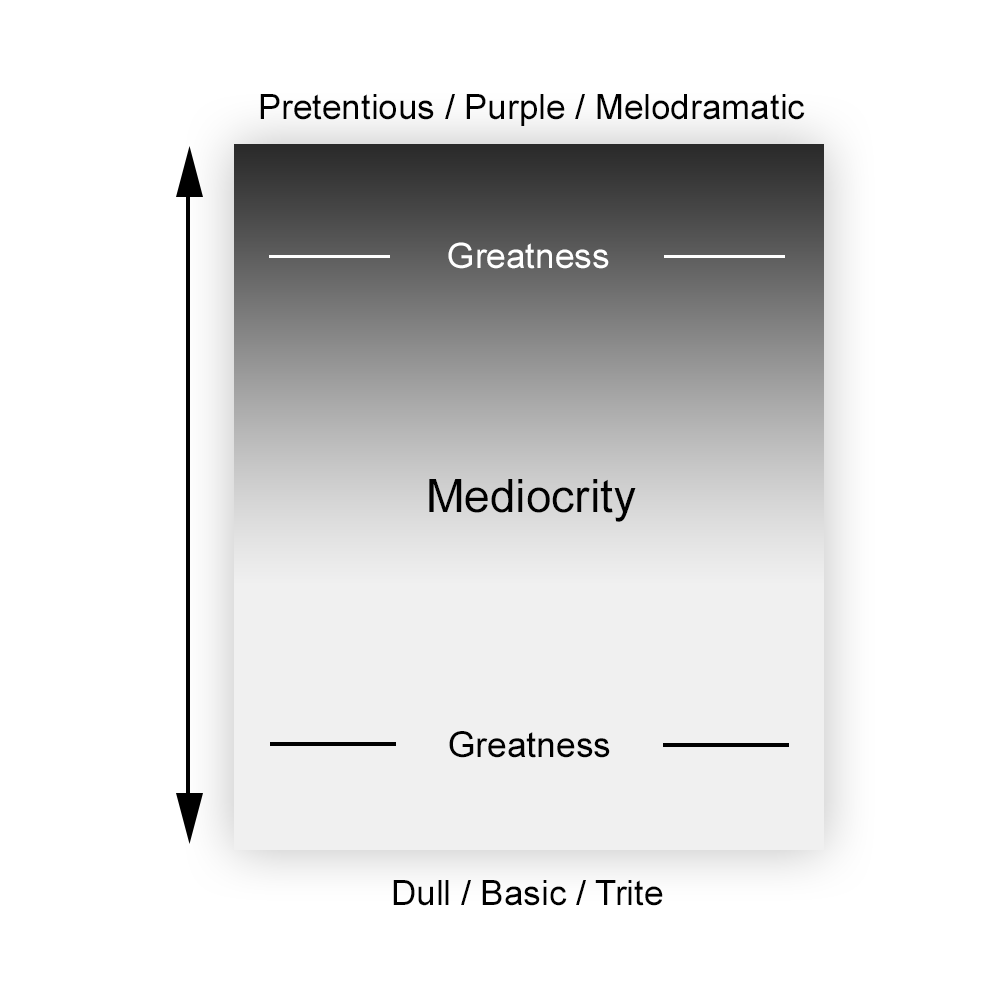
I call it the 91% rule…
72
Thu 25th Jan 2024
Everything you’re trying to do at the moment is forced.
Chill.
Read some books.
Watch some films.
Play some games.
Let yourself heal and build back up again.
You fully understand that it’s okay to work on something just for the fun of it, even if no one ever sees it.
The problem is, there’s nothing you really WANT to work on right now.
Wait until the right thing comes along.
Be a sponge for inspiration.
You’re not broken.
You’re not giving up.
You’re cooling down for a while.
73
Thu 11th Jan 2024
I always want to write literary fiction. To me, it’s the highest form of art. But it seems there are only a few different "plots" that literary fiction can have. Anything else, and it becomes something else. For example, if it centres around a big mystery, maybe it’s a mystery? If it’s thrilling, then maybe it’s a thriller?
Here are what I believe are the true literary plots. I believe all of the greatest novels of all time contain at least a handful of these...
- A loved one dying, grief
- A physical journey
- Community and family
- Trying to protect loved ones
- A search for peace / meaning
- A need for redemption / forgiveness
- A physical / mental struggle, endurance
- Loneliness, confinement
- Depression
- Curiosity, studying, meditating, learning
- Growing obsessed
- Madness descent
- Transformation
- Existential confusion
- Giving in to the worst self
All of them must involve inner turmoil.
74
Mon 2nd Oct 2023
If at some point you lose perspective of this book...
Write a splurge about what you want it to be, and how you want it to feel.
Already written the splurge? Read it.
Update: Already read it? Write another one.
75
Mon 3rd Apr 2023
Write in a quiet room with no distractions.
76
Thu 11th Jan 2024
Think about what you DON’T want this book to turn into, and think about how to avoid it.
77
Tue 6th Feb 2024
Get GOOD at figuring out what makes GOOD things GOOD.
I can’t overstate this.
78
Mon 16th Oct 2023
When I imagine someone reading this book, I just want it to be unrelentingly beautiful and visceral – you can’t look away, just beautiful haunting thing after beautiful haunting thing – a baby’s death followed by planets colliding, followed by wandering through a broken town – all strewn together – a real symphony.
Not beauty in a superficial TCOS way, but with real meaning and purpose, with not a single paragraph out of place, you just want to keep reading because you love it so much and it makes you smile and it makes you cry
79
Fri 9th Aug 2024
While writing the novel, after every few weeks, write a ramble. Switch your mind off and splurge about the book – what it’s supposed to be, what you want it to feel like. This will help you stay on track.
80
Tue 26th Sep 2023
I actually think that Donald Maas book might’ve ruined a few of your past novels. He always talks about raising the stakes, adding tension, pushing every scene to its absolute emotional limit. But your favourite books don’t do that. They’re subtle, grounded, realistic, gentle, explorative and patient.
81
Tue 3rd Oct 2023
Always hold the FEEL of the book in your mind, like it’s a memory. Like it’s a book you’ve already read, and loved, and you can experience the thing as a whole, even if you can’t remember all the details.
82
Mon 22nd Jul 2024
For me, the most important aspect of writing a book, is holding onto the FEEL of what I want the finished book to be. If I lose that, it’s all over.
I won’t know every detail of the book, I’ll only know what it feels like, and the feeling is distinct and specific and perfect and impossible to summarise.
So I send myself reminders, I write mini essays about what this book feels like – elements I mustn’t forget, elements I definitely mustn’t add. I tell myself what the book is and what it’s not.
I listen to music that contributes to the feel. I try to only read books that contribute to the feel. I create documents that contain nothing but a list of words that give a flavour of the feel.
I write myself muse statements, manifestos, instructions for how to get back into the feel if ever I should lose it. I try not to read the work I’ve written, in case it doesn’t feel like the feel – and I’ll just write and write, slowly translating the feel from my mind into the document.
If I’m lucky, I’ll manage to hold onto the feel until the project is done. If I’m luckier, the thing I’ve created IS the feel.
83
Tue 17th Oct 2023
While you’re writing it, try to go as long as possible without reading it. When you read it, you’ll start to become more familiar with what’s there than what’s NOT there.
You need to become familiar with what’s not there. This is where the magic is. This is where the creative fuel is. This is where the rest of the book is. So don’t lose it. Hold onto it at all costs.
I think when you read it, that’s when you see what the book IS rather than what you WANTED it to be, and that’s when you get discouraged and lose the true feel of what the book is meant to be.
Every time you sit down to write, write the next bit you "feel" is missing.
Keep writing until you believe you’ve ticked every box, you’ve filled every hole, you’ve taken every element, every feel, every atmosphere and character moment and written them down. Write until you’ve got nothing left.
And then read it.
84
Tue 11th Apr 2023
Write the bits you KNOW you need to write while your mind stews on the rest.
85
Tue 11th Apr 2023
When in doubt, just start writing. Write fast, lucid, stream of consciousness. Don’t overthink it. Even if it’s shit. Get a feel for it. Experiment. Don’t worry.
Assume it’s already a masterpiece. Now write it.
86
Tue 11th Apr 2023
Walk, eat right, fast, drink water, breathe.
87
Mon 22nd Jul 2024
Why walk?
Because it’s nothing. It’s not reading. It’s not listening to music. It’s not looking at your phone. It’s fresh air for the body and the brain. You need moments of ‘nothing’, otherwise your brain can’t stew, can’t create, can’t weave, can’t tinker, can’t grapple, can’t play, can’t think, because it’s always consuming somebody else’s something else.
88
Tue 11th Apr 2023
The word count really isn’t that long, so a few great scenes and events will see you through.
89
Sat 11th Mar 2023
Write fast, edit later. It took Ray Bradbury 9 days to write Fahrenheit 451. Write like you’re reading. Like it’s natural. Like you already know what it’s going to say. Don’t overthink it, just write. Be yourself. Almost stream of consciousness. You can do that.
90
Mon 27th Nov 2023
Are you stuck, but you have a list of scenes to write? Create a little synopsis for those scenes – where the characters are, what happens, what they say, why they say it, how they feel – it’ll help you visualise it better, find any potential issues, and write it.
Still stuck? Of all the bits you know you need to write, pick one and write it as a very short scene, like in The Road, and see where it takes you.
Update: Sometimes it helps to assign a word count. "I need to write 200 words for this scene". Now you have a tangible goal.
91
Tue 21st Mar 2023
Make sure to read well-written books.
92
Thu 23rd May 2024
Sometimes things that sound trite when you first write them can seem great after a little bit of time. And vice versa, unfortunately.
93
Mon 15th May 2023
Don’t overthink any of it. Clear your mind. Go somewhere quiet. Read through the book and add what you feel it needs. Sit down with a blank document and write scenes straight from the mind, focusing on character.
94
Tue 21st Mar 2023
Do NOT spend another half-year stressed and pressured and not enjoying your writing. You can easily finish this novel before the deadline. Write as much as you can.
Enjoy it.
95
Mon 18th Dec 2023
Words I think I use too much in my writing:
feel / felt / feels
look / looked / looks
watch / watched / watches
walk / walked / walks
glance / glanced / glances
96
Thu 15th Jun 2023
If you choose big themes, you can trick people into thinking the book is deeper than it actually is!
97
Wed 27th Apr 2022
Every time you feel like you’re about to give up on the book, or need a break from it, it usually means there’s something wrong in the manuscript. It’s not that you’re exhausted, it’s because something is wrong, so the whole thing feels wrong, so you want to give up.
Be honest with yourself about what’s wrong. Once you figure out the answer, the block will evaporate.
Can’t figure out what’s wrong? Talk to yourself. Ask yourself questions. Walk.
98
Fri 22nd Dec 2023
Imagine one of your books gets published by your dream publisher. Make sure everything you write lives up to that standard, or better – artistic integrity, specific, organic, no forced plot, character driven – and don’t fall back into old habits of every scene just being a direct route, obvious, one-note, plotty, genre, trite, convoluted. You are not writing a film script. You are painting with words.
99
Thu 11th Jan 2024
Imagine the book is finished, and someone who should like it says it’s shit because X.
What is X?
100
Mon 8th Jan 2024
Make sure there are layers to it.
101
Mon 13th Nov 2023
You seem to get to a point in every project where "the feel" kind of evaporates from your mind and you have to hope you’ve created enough to continue.
You do still know what the feel is, you’re just not feeling it strongly. Or maybe you’re just so accustomed to what it feels like, it just doesn’t feel new any more.
Maybe the feel is gone because you’ve written a lot of it. You’ve captured it. It’s out of your system. You don’t need it to only exist in your head any more.
Read your splurge.
102
Wed 19th Jul 2023
If you were gonna write something batshit crazy for a modern audience who isn’t surprised by anything, that people would actually talk about, that would shake the world, what would it have to be?
103
Mon 8th Jan 2024
Think of the greatest novels of all time. What would your book have to be to sit among them? You can do that, you know.
Get excited about that.
104
Thu 23rd May 2024
I think what spurs me on sometimes is the idea that at some point in the future I will be considered among the greatest authors of all time. It makes me want to put my full effort into every sentence. It makes me treat the book with the reverence it deserves, to live up to my future esteem.
105
Wed 22nd May 2024
Read the best scenes you’ve ever written. Remind yourself that you CAN, in fact, write. Remind yourself that the bar is high.
106
Fri 3rd Feb 2023
If you suddenly found out that your brain had been turned to mush, and now you’ve woken up and were able to take an objective look at your life – mainly your creative projects and overall creative dreams – what are you doing wrong? What could you do to achieve more? To get further? What could you be doing differently to live a better life?
107
Thu 9th May 2024
Just remember, to get another chance at being published, all you have to do is write another novel.
You don’t only get one shot.
And every novel is another little addition to your personal library.
108
Thu 9th May 2024
I always thought "believe in yourself" was shit advice.
So if I believe in myself things will magically happen?
No. If you believe in yourself, you’ll keep trying.
109
Thu 31st Aug 2023
If you found an agent, and you knew you were going to be published, how would you feel? How would things change?
I honestly believe I’d fall in love with writing all over again – I’d write more and more, and read books, and care about literature more than ever. I’d be excited.
Because I’m in now. I’ve done it. I am a part of this life, and this life is a part of me. I can talk about writing with confidence, I can help people.
I think sometimes the music and games etc are just a distraction from the pain and rejection of writing, and realising that the novel you just wrote is dead and won’t be published and you’ve given up on it and have to find hope all over again. It’s quite sad really. This may not always be the case. Your tastes do change. You do enjoy doing other things. Sometimes you really get into it, watching gamedev videos or getting truly obsessed by music. But right now, if you’re really honest with yourself, you’re distracting yourself until you throw yourself into the next novel. You’re scared that if you never get published, you’ll have nothing else that you’ve created.
But. If you could just accept that you truly enjoy writing, that you love it even if you knew you’d never be published, then you’ve done it. Because you’ll enjoy it, and also you’ll be getting better and giving yourself more opportunities to be published, and if not, you’ll just move onto the next one.
Maybe you need to get out of the house. Go and write in the library or something. Make a little adventure of it.
It’s time for a change. It’s time to let go of the dreams that are holding you back and just write because you’re a writer, an artist, you want to explore great literature. It comes from within.
Why do you want to be a writer?
I think it’s for validation, to know I did something great, to have people enjoy my work and want to see the next thing, so it feels less pointless.
I go through periods where I don’t even care about books, and writing doesn’t drive or excite me. But it always feels like the highest art form to me.
And I like that. I like feeling like I’m making something "great" that will affect people rather than just making something "fun". It feels like a more satisfying use of life.
In all honesty I’d like to have "fans" that enjoy "me" and all the different things I do. It makes those things feel more worthwhile to know someone will actually see the things I make.
Are there ways to get what you want without becoming a published author? Would people who enjoy your writing care about anything else you do? Can you be happy without it? Aren’t you pretty close to finding an agent and just need to keep trying?
110
Thu 31st Aug 2023
I need to think of a way for the words to come. If I can do that, I’ll write and never stop.
Maybe stop planning it. Write whatever comes out.
You sometimes feel like life lacks a bit of meaning, you’re just living the same day over and over, and at the same time it’s all passing you by and going too quickly.
You want to be a writer. Well maybe the way to find meaning is to try harder. Be obsessive about it. Write more. Write deeper. Write better.
111
Tue 23rd Jan 2024
You have lots of ideas for novels, and a lot of the time you get discouraged when you think "this idea could never get published"
But here’s the thing...
YOU CAN ALWAYS WRITE ANOTHER ONE
so just write it
write for the sake of writing, not to get published, not for ego
write for the love of art
Don’t think about the potential outcome. Focus on making the best thing you can possibly make.
112
Thu 24th Aug 2023
In hindsight, the art novel isn’t that good. It’s got good bits, but it doesn’t maintain it.
In fact, none of the books you’ve written so far are that good.
You’ve also realised that the world isn’t just full of shit writers. It’s also full of very good writers trying to make it, just like you.
You still have things to learn about writing – things you can only learn from reading and writing – and this is good. Something to work towards. An opportunity to get better. Your next book could be really good, if you maintain a high poetic and real character standard and don’t compromise yourself into plot.
113
Tue 29th Aug 2023
Don’t beat yourself up. Go slow if you want. Enjoy your actual life.
114
Thu 23rd May 2024
Writing rules help you write a popular book. One that will be forgotten in a year. They don’t help you write a great book. That only comes by breaking the rules.
115
Thu 24th Aug 2023
You get discouraged when you’ve finished a book, agents have said no, and now you’re back to square one with a book no one will read.
It’s hopelessness. But if you can find a sense of hope with a new book you believe in, that you believe stands a chance of finding an agent, you’re fine.
So write. And maybe be a bit more obsessive about it – write more, try harder to make it a masterpiece.
And if you can, find other things in your life that give it meaning. The kids are a big one. How could you derive more meaning with them?
116
Thu 27th Jul 2023
You’ve learnt that you need to do two things:
- Write with the goal of getting traditionally published
- Release art to the world, even if no one sees it
This means you’re working towards your main life goal, but also you’re releasing stuff just in case that never happens.
Whatever you make should be honest, personal and beautiful. A piece of art in its own right, rather than how-to, or vlogs, etc.
I think as long as you’re doing some serious writing here and there, you can do all sorts of random shit (literally anything from making games to learning guitar), and you don’t need to feel bad about it, just enjoy it.
And that’s pretty exciting. Just working on whatever takes your fancy, the most random pointless shit if you like. Safe in the knowledge that you’re also doing the real stuff, the stuff that has meaning. Writing.
117
Tue 29th Aug 2023
You’re frustrated that it’s hard to "get your work out there". You always have been. But stick to your plan – writing some days, and creating random shit on other days.
Also, the whole agent/publisher model isn’t bad. At least it exists. Rather than just creating stuff and not being able to send it anywhere.
118
Mon 8th Jan 2024
When you’re between novels you ALWAYS feel guilty about not writing.
So write.
Write ANYTHING, not worrying about it getting published, it’s just practice, like an artist flexing his painting muscles.
Use your schedule. It’s the "I’m between novels" schedule.
Now is the time to do other things because you need to STEW on an idea before jumping straight into another novel.
Don’t feel guilty. This is necessary.
Make games. Make writing videos. Do some paid work. Be with the kids.
And read.
And write a couple of times a week, so you keep up the quality.
And don’t worry.
119
Thu 20th Jul 2023
When you think about writing a book for zero readers, it makes you want to give up.
But when you imagine showing family or friends, or looking at it in 5 years, or 20 years, or letting the kids watch it when they grow up, it feels worth it.
And you should think about that with any creative project.
120
Wed 19th Jul 2023
Never feel guilty for doing things that aren’t writing. There is always time to write more books. But in 20 years when you look back, if you’ve never been published, you want to see that you created all sorts of things other than novels rotting on a shelf.
121
Mon 10th Jul 2023
What you are is someone who enjoys ideas, visions, concepts, and then tries to bring them to life in beautiful ways, ideally through words.
In many ways you’re a poet. You enjoy stream of consciousness, painting with words, sometimes setting a scene. You’re good with portraits, but these can’t be forced, they have to come at the right time, usually starting with a concept.
You NEED "concepts". And often you hope that this concept is enough to see you through a whole project, and this is usually achieved by splitting it into smaller concepts.
122
Mon 10th Jul 2023
Every scene is an idea. It’s a curiosity cabinet and every compartment is an idea. The trick is weaving it all together.
123
Thu 18th May 2023
Although you’re going to get disheartened, and sometimes you’ll hate writing, and sometimes you’ll get bored of it and work on other projects, the writing will always be there.
And there is a clear path forward.
Write.
Submit to agents, literary journals, magazines and competitions.
Repeat.
124
Wed 31st Aug 2022
The only thing you’d ever TRULY want to be successful for is being traditionally published.
I don’t think you’d truly be fulfilled if a particular piece of music took off, or if a game you made became popular.
Every time you do some crazy video idea, it’s ego more than anything. You want to be seen. You want a record that you existed. You wanted to get some of your illustrations and music out there. You’ve done that now. And you can still do it whenever it makes you happy.
But for the most part...
Just write.
125
Wed 31st Aug 2022
Imagine giving yourself two or three separate opportunities to be published every year. And even if you don’t succeed, you’re building up a body of work you’re proud of, so when it does happen, you’ve got more books ready to go.
126
Wed 31st Aug 2022
Let’s say you got really successful to the point where you don’t need to work, you can just spend your time doing whatever you want to do. What would you want to do? WRITE!
So just write. Make hay while the sun shines. Read too. Do stuff you can be proud of, no matter what happens.
Maybe it’ll never happen, but think about the closest you ever came. It was all from a competition. You got close. Keep going. You wouldn’t want it to happen too early in your life anyway.
127
Sat 30th Dec 2023
Why do you want an audience? So you can have the freedom to create whatever you want whenever you want?
You can already do that.
So do it.
128
Wed 26th Jul 2023
I think the trick is to make something you love, and not care how many people see it. But maybe someday they will. Just keep doing it, like Henry Darger. Preferably one project that just grows and grows.
A project that defines you.
129
Wed 26th Jul 2023
Why writing isn’t a waste of time even if no one reads it:
- you enjoy it
- it makes you a better writer
- some people WILL read it, even if it’s only friends
- you’re leaving something behind, however small
- each book is another shot at publication
- you’re building up a body of work
- maybe they’ll still be published one day
- you can be proud of it
- it’s the one thing you truly feel like you’re meant to do (even if you don’t always feel it)
- it keeps you focused
- it gives you hope
- what else are you going to do?
130
Thu 20th Jul 2023
Maybe you need to get more involved. Attend more things – workshops, etc, join jericho writers, post on forums.
131
Fri 2nd Jun 2023
If somebody told you that in the future you’ll be regarded as one of the greatest writers of all time, what would you write? How would you write it? What are the words?
You can do that. You are human like all the rest.
132
Mon 13th May 2024
Get into that flow state where you’re not just "going through the motions", you’re writing beautiful language in an interesting way, saying "and", "and", "and", "and", like a Listener song, like a poem, like the words are coming from somewhere else, like they already exist, like each word matters, like it’s divine and important, like they deserve to be hand-bound in a giant book, like people could learn to remember these words as if they’re a song – not just words for the sake of words, but perfect words of confidence and mastery.
Don’t think about the "plot" – switch your brain off and just write in that dreamy state full of poetic language, making sure it makes sense, have something to say – and don’t forget human connection and emotions – but focus on lucid beauty and stream of consciousness – don’t plan it, don’t understand it – just write in short bursts, short poetic vignette snapshot scenes – don’t think about getting published, enjoy the process of just being a writer.
133
Thu 9th May 2024
You raised the level of your writing with your last book. Make sure you carry that through to this new one.
For each new novel, ask yourself specifically how it could be better than the last one.
134
Fri 26th Jul 2024
My favourite ideas are the ones that allow me to write anything I want – all the best things I can think of – and weave them into a thematic narrative.
Anything less than that – anything constrained by story – is by definition NOT the best thing I can write.
Maybe this is how I’ll always write now.
135
Thu 16th May 2024
It’s good to treat every novel like it’s the last novel you’ll ever write – it’ll make you try harder to make something truly great.
But also, stop doing that. It’s stifling, and it makes you not want to start. It doesn’t let you get messy, make mistakes, explore. It doesn’t let you write things just for fun and practice, just for having another shot at publication. The good comes out of the bad.
Just write. Pick a scene idea and write it.
136
Wed 15th May 2024
To write, I don’t need to know what the story or concept is.
But I do need an idea for a character, place, and situation (as many of those 3 as possible). From there, I can write a scene. From there, I can write anything.
It’s like 2 separate processes. Thinking of the scenes, then writing them.
I don’t think I can just sit down to write with NOTHING to go on.
It’s the scene ideas I struggle with. The words tend to come fairly easily.
So make a list of scenes, with details.
137
Fri 17th May 2024
The bits you love in your last book are the rambly bits. Rambling about the specifics of the surroundings. Rambling internally about what a character is experiencing, their thoughts, their pains, without being on-the-nose.
The scenes in between are much more standard description, dialogue, action. And they can still be attractive, poetic, specific, human, personal – but less so than the rambly scenes.
When you’re starting a new novel, you’re always daunted by the good bits of your last book. You’re trying to write something as good as that.
But those bits, the masterful rambles, come over time. You need to write to get there.
And it doesn’t have to be an overt go here, meet a person, do a thing, say this, next place. It can be more loose, more clipped, more verse, more precise, like poetry.
138
Mon 22nd Jul 2024
When you think about James Joyce and Ulysses, that’s when you want to write something grand and epic without a necessarily emotional thread. But the rest of the time, you need that character, that emotion. Neither is bad. But your Ulysses can wait until you’ve got your foot in the door.
139
Tue 16th Jul 2024
On speech marks…
There is a thing that happens when you lay down your first speech mark. It says to the world, and to yourself, what I’m about to write conforms to everything that came before. It follows the rules set by an arbitrary stranger in some distant past. It has nothing new or interesting to offer. These rules are so ingrained in me that I cannot conceive of doing things differently. I am enclosed.
You could reply, but they’re for clarity! If you’re not using speech marks, why use full stops or commas or anything else?
A speech mark is unique because it is reserved for a specific mode of writing – dialogue. It is not universal to all writing – it is an imposition, a restriction, a safety harness, an ugly set of training wheels fixed to the sides of our words. Our writing can be absolutely clear and grammatically correct without them.
When I speak to you face-to-face and I tell you an anecdote full of dialogue, you don’t need air quotes to let you know which parts are speech. You just know.
This doesn’t mean you mustn’t use speech marks. It’s just a question to ask yourself, to avoid falling into old patterns without interrogating them.
140
Tue 23rd Jul 2024
If you’re not careful, your characters can "pretend to be real". Of course, no characters are real – that’s why they’re characters. But we also don’t want our characters to pretend to be real, with their big personalities, their faux-realistic speech patterns, their plotty wants. A character should be natural. A character should be authentic. And this means we observe them, we watch their lives unfold, we hear what they’re thinking. When they speak, they say small and simple things, or bold thematic things, without ever telling the story. They never say things just to seem more real. They are not pretending. Their intrigue comes from their thoughts and their actions.
141
Thu 25th Jul 2024
Dialogue is a kind of roleplay. We know these people aren’t real and never said these things. And yet, rather than have them say very precise and poetic things, you’re making them say these realistic mundane things to make them seem more real. But it’s a trick. It’s false. They are pretending. And in pretending, some of the artistic integrity is lost.
Instead of our characters pretending to be real when we know they’re not, they should simply be artistically honest. Their speech should be true to the story and its themes, not some cheap imitation of real conversation.
142
Tue 23rd Jul 2024
Dialogue is often like seeing a painting of a dramatic scene, and the subjects in the scene have speech bubbles painted at their mouths.
143
Mon 8th Jul 2024
We’re always taught…
- our characters should want something
- our characters should be trying to do something
But this is when (for me) a book starts to feel cheap. In the death novel, we could say that Travis "wants" to not be lonely. We could say that Dalia is "trying" to be a good mum. But these aren’t generally what we mean by wants and trying in fiction.
Instead we’re just experiencing their lives. We’re watching them unfold. We are seeing their emotions, their thoughts. Things are happening. They are active agents, but they are not striving for something in a plot sense. They are not trying to achieve something, or prevent something, or get something. The story exists in the same way a story exists in a painting. And it feels more real. It feels deeper. We are seeing a snapshot of a real life, and the events of it.
I’ve grown bored of plot. We’ve seen every plot a million times.
I’d much rather just have an experience through language.
144
Tue 23rd Jul 2024
Everyone says "show, don’t tell", yet they’re all telling stories.
145
Mon 15th Jul 2024
This is very important – this art/entertainment divide. It feels very clear to me now, and I don’t know if enough people recognise it.
When you write art, you’re not pandering. Not compromising. You’re not being an entertainer. You still hope people will enjoy it and find it emotional. But it is a painting, not a theme park ride. The characters can still talk and interact, but they are not pawns whose job is to be entertaining and tell the story. We are just observing.
There’s nothing wrong with entertainment. This is just something different.
What I’m trying to say is, I think a true literary piece of art doesn’t have those kinds of character moments and plot where it’s clear we’re being told a story, and the characters are interacting in very mock-real ways, saying mock-real things, trying to do plot-things - this can seem real but it’s also false. It’s a cheap trick. Because we know it. We KNOW these people aren’t real, so why are they pretending? I’d much rather just drop the reader into a setting and show these characters interacting without those bells and whistles - direct, precise, important. I think this is MORE real, because we’re no longer pretending. It’s no longer a piece of entertainment with oh-so-compelling events and oh-so-charming characters. The whole thing becomes simply an emotional experience of moments.
And maybe I’m kidding myself by believing we don’t need these mock-real characters. Maybe my next book will be lessened because of it. Maybe these moments are what make us truly connect, and make our characters feel truly human.
But I have this unshakeable feeling that these character interactions (especially dialogue, and especially that kind of mundane realistic dialogue) are what lessen it. They make it cheap, obvious, pandering, cartoonish, and ultimately false. No matter how well they’re executed.
Here’s the crux to it:
I’ve grown to hate those bits in my novels where we see characters interacting, saying very down-to-earth relatable things, just to help the reader empathise. To me, this is them "being a character". It all feels like a "show", and the same is true for plot. Integrity is lost. It’s no longer a work of art, but a product. I’d rather have no dialogue than this false realism.
I don’t want my character interactions to serve the reader. I don’t want my characters to help the reader along by pretending to be real and human, throwing in little character-moments and charming little bits of personality. I think that’s patronising. I want my character interactions to contribute to this image I’m painting. The things they say are not on-the-nose, but they are pertinent to the moment. Every word matters. As precise as poetry, even at the expense of realism. For me, their "lack of pandering" actually renders them more realistic, more honest, more sincere. Because I’m no longer pretending.
146
Tue 23rd Jul 2024
The majority of their realness can come from internality. Internal streams of thoughts. This can do the heavy lifting. It’s more real, direct, and literary. It can be deep and complex and strange. When they speak out loud, they speak simple things, never pretending to be real, never telling the story.
Show the complex emotional lives of these characters, not through dialogue, but through inner monologue and stream of consciousness. Make sure when you go introspective you go very deep and personal, with unusual specific thoughts, highly particular and interesting – this is what makes good literature.
147
Tue 23rd Jul 2024
Internal thoughts, especially stream of consciousness, allow you to get to the deep direct inner truth without needing to mask it through dialogue. Dialogue should never be on-the-nose because people don’t speak like that and it’s too obvious – so forget it – let’s not play that game - cut out the middle man – get straight to the inner world where people DO say exactly what they’re thinking – all their deepest darkest weirdest thoughts. Now we can be realistic AND direct. Now we can show the truth without mangling it through false dialogue that no one said. We can still have plenty of subtext, because subtext is fun, but we don’t have to jump through contrived hoops to get there.
148
Tue 23rd Jul 2024
This is not a play, where the narrative relies on people speaking. It’s a novel. Novels have unique ways of telling stories, and we should use them.
149
Mon 15th Jul 2024
Entertainment exists to serve. Art exists to express.
150
Tue 23rd Jul 2024
Never say:
This is how things are, and I am right, and this is the truth about the world, about humans, about politics – I am telling you how things are.
Say:
Watch this. Look how this unfolds. Do you see any truth in it?
It’s like "show don’t tell", but on a macro scale.
151
Fri 26th Jul 2024
When you say things that don’t quite make sense, you’re forcing your brain to work in novel ways.
152
Thu 18th Jul 2024
I think what I’ve grown to hate is conflict BETWEEN characters. Which might sound crazy.
For me, that’s when the drama becomes like a soap opera. Internal conflict is fine. Conflict with the outside world is fine. But if I’m trying to delight you with the conflict between two characters, I am a puppeteer putting on a puppet show.
Update: No – conflict between characters is good, if it’s deep and thematically relevant. It’s ‘bickering’ I don’t like. Shallow conflict. Conflict without true emotional stakes. But I love to see two characters who care for one another have some kind of conflict between them.
153
Sun 28th Jul 2024
If I’m being absolutely honest, I don’t like "characters". They feel old fashioned to me, like a pantomime. You might ask, how can you have a novel without characters? The answer: in the same way as poems, songs, and so many paintings.
154
Sun 21st Jul 2024
My favourite way to write a novel is to pick a theme that’s close to my heart and then expand on it and delve deep into it and explore it, preferably centred around some simple human moment or ordeal.
155
Sun 18th Aug 2024
Don’t write the best book ever.
Write the best book about X ever.
156
Mon 29th Jul 2024
I want every novel I write from now on to be a true opera for the senses. Not just "once upon a time there was this man..." (although even this can work if it’s done in a precise poetic way).
There are things coming in and things going out, things that crash together, and they rise and fall and each element contributes to this thematic piece, exploring the deepest depths of the human soul and the most ecstatic profound blinding light – not just work but pure artistic play.
We don’t write like this enough. The "novel" has become a stock thing, a tool in itself, constrained, rather than having the freedom of a painting.
It’s amazing, because in this "opera" I’ve almost found a mode of writing where I don’t care if anyone sees it. I enjoy it. I’m writing this when I know it has very little chance of being published as a debut novel, and I don’t care. I’m writing it because I love it, I’m proud of it, and I want it to exist.
I feel like I could write loads of these operas – from surreal and epic journeys across impossible lands, to canterbury tales pilgrimages. This is me.
157
Mon 29th Jul 2024
I’m someone who has lots of little ideas. The trick is turning them into a few big ideas.
I think the "opera" method is the crux to it.
158
Mon 22nd Jul 2024
Write the things AI cannot write. And when it can, the job of the human is to write the next thing AI cannot write.
159
Thu 25th Jul 2024
On writer’s block:
I’ve found it helps to start with the word "and".
160
Mon 12th Aug 2024
One of the best things I’ve ever done as a writer is to keep my day job. With my day job paying the bills, there’s no pressure for my writing to pay the bills, and therefore no pressure to compromise my work by making it appeal to the mainstream.
161
Wed 10th Jul 2024
Often, as soon as you have a message, as soon as your work is saying something, making a point, some of the art is lost. Sure, something can be gained – the work can take on a different meaning, it can make an important case – but some of the art is lost. Because it’s no longer existing for its own sake. It’s no longer a thing to be felt. It’s an essay made pretty. If any meaning is to be found, it should be incidental. It should be emergent.
Update - It’s important to know what you’re trying to say, but you should never preach. You need to say it without saying it. If you say it, explicitly, then you might as well have just said it in a sentence rather than writing a whole novel. A story allows us to experience a truth.
162
Mon 12th Aug 2024
If you can learn to cherish NOT having an audience, then you’ve cracked the system. When you don’t have an audience, you are living in a state of absolute artistic freedom.
163
Thu 22nd Aug 2024
There’s nothing I could write over the course of five years that I couldn’t have written in five months. If I spent much longer than that, I’d just be pushing the words around like cold food on a plate.
164
Wed 21st Aug 2024
If writing were a form of therapy, what deepness would you write?
165
Wed 21st Aug 2024
Make sure there’s some real SUFFERING in the novel, otherwise what’s it all for? What’s being triumphed over?
166
Sun 29th Sep 2024
I like my midpoint to come slightly too late, because I want the second half to be quicker.
167
Mon 30th Sep 2024
I’m not sure if I could’ve written any of these thoughts/advice/tips without first spending several years learning the basics – the classic techniques – characters, pacing, tension, structure, and so on.
168
Thu 22nd Aug 2024
I hate all those nothingy in-between words – with, that, was, the, a, by, to, have, is, it, if, there, are, than, in - if there are more than three of these in a row, your eyes start to glaze over. It’s empty language. There’s no substance to these words.
169
Fri 23rd Aug 2024
I enjoy poetry but I don’t enjoy poems.
170
Mon 2nd Sep 2024
I think "the novel" has been trying to achieve the wrong thing for a long time.
I love novels but I’ve grown weary of "stories". They are starting to feel overdone. Stories are fun, but they are the packaging, the means to an end. Stories are important – a great story can change the world – and we’re lucky to have plenty of them. But we have heard every great story in a hundred different guises. For me at least, it’s no longer the story that’s interesting, so much as the guise. The expression, the language, the poetry of it.
To tackle this "stale story" problem, we hear a lot about "complex characters". Characters with deep psychological nuances, personalities, wounds, motivations – as if this is the key to good fiction. But I’m not a psychologist and most novelists are not psychologists. We are artists and we are poets. Our sentences do not need to build complex and realistic portraits of a person or a relationship. They need to paint a picture. To show a scene and let the observer make up their own mind. Our sentences should exist as a piece of art in their own right, to explore a setting, an idea, a theme, to express an emotion, to move the reader.
To this, someone might say, how can we move a reader unless our characters are sufficiently complex? And of course, there are exceptions. There are great literary characters that are extremely complex.
But does a painting become less beautiful when the subjects aren’t carrying out complex tasks, complex conversations, complex thoughts, with a complex backstory and complex motivations? A painting cannot show us these things. In a painting, we observe the scene, and we feel what we feel.
The beauty lies in the particularities, the specifics, the composition. The complexity lies in what’s left unsaid, invented by the observer. We do not need to create psychologically complex characters – that’s backwards – instead, we need to tap into the deepest parts of ourselves and lay it on the page. The reader will feel what they feel, and what they feel may be complex. And this complexity is often different for each reader, leading to further emotional nuance.
To reiterate – why should a novel be like a painting more than, say, a film?
Stories are crucial, but they are not all the novel can offer. Stories, alone, are in danger of becoming as old fashioned as the bard’s ballad. It’s everything around the story that’s interesting to me. Stories are surface-level – we need to look deeper - not by creating complex characters, but through introspection. There are infinite ways of looking at ourselves and the world – infinite thoughts, infinite poems, infinite paintings. We will never run out of these.
The novel isn’t dead. Neither is the story. But every good novel is a retelling of an old story, whether by accident or on purpose. And this is a good thing. But if the novel is to endure, we must realise it is much more than just the story it’s telling.
Our "story" is simply what emerges – something familiar – a journey, a struggle. Our "story" is the sense of time that distinguishes the novel from the poem. Our "story" is the canvas. What’s truly beautiful is the painting. Your painting.
171
Thu 5th Sep 2024
Recently I’ve realised how much effort I pour into actively cultivating my inspiration throughout the course of writing a novel. Watching videos about writing – specifically interviews with authors – reading great prose, listening to music new and old, reading my favourite paragraphs, going somewhere new – all in the service of keeping my mind fresh and engaged for the next writing session.
172
Fri 6th Sep 2024
Creativity is the antithesis, not of destruction, but of consumerism.
173
Sat 7th Sep 2024
If I write a worse book than the last, it won’t be because I’ve suddenly become a worse writer, it’ll be because it was a worse idea.
174
Sun 8th Sep 2024
Every rejection has forced me to grow. It might be a tragedy, the day I don’t get rejected.
175
Mon 9th Sep 2024
I’ve said this in a hundred different ways but I really want to ram it home. Stories are wonderful, but personally I’m tired of storytelling. Once upon a time there was a person, and this happened and this happened and this happened – I’m bored of it. What I want to do is create a setting and let it live. I want to create an emotional sensory experience through language, while exploring a theme or themes. That’s all.
And technically it could still be called a story. But I never want to approach it that way.
176
Thu 12th Sep 2024
Put the weirdest stuff in the second half.
177
Thu 19th Sep 2024
Truly great literature is new and old.
178
Thu 19th Sep 2024
If I don’t fully understand what I’m writing in a given paragraph, that’s a good sign. That’s where the magic is. It’s truer than true. It’s true before words. It’s coming from somewhere direct. I’m writing it because I have to.
179
Fri 20th Sep 2024
I’ve grown tired of that standard mode of storytelling that almost every novel uses. Just shuffling through techniques – maybe a bit of description here, followed by a character action there, then the character says something and the other character reacts. Maybe a sentence or two of backstory and inner monologue, and now the second character speaks – and on and on and on it goes. It’s so normal we take it for granted. We assume that if it’s fiction, it has to be written like this.
But we can write anything! Anything! Our 75,000 words can be filled with anything at all. We can delve deep into ourselves and write pure language, pure thought, pure feeling, pure art – proclamations, poetry, chants and abstract ramblings of the soul.
I’m not saying it’ll be a random mess of thoughts and ideas barely tied together. I’m saying we have the freedom to write in different and new modes – modes without a name – to tell the story without telling it, without the storyteller, without once upon a time.
A story can still unfold. We can still have characters. We can even have a classic four-act structure. But at a paragraph level, we’re not going through the same old motions. Not just "action, dialogue, description", as if we’re describing what’s happening in a film. This is why people say the novel is dead. If it’s emulating other media then of course it’s dead, even if it’s still breathing.
We can and must use the language. We must write what only words can say.
This is art. Other kinds of art evolve in almost unrecognisable ways – painting and music especially. For too long we’ve been blinded by what we think a novel is. We can write anything.
180
Tue 24th Sep 2024
Learn everything and then forget everything.
If you don’t learn, you’re in a dark room trying to build something. It’s too dark to see the tools or the materials. But you try regardless. You might create something great – something accidentally genius. More likely, you’ll make a mess.
The bulbs come on, you’re in a well-lit room. Now you’ve learnt everything. Now you can create something better because you can see what you’re doing. You can see your tools and your materials. It is comfortable here.
But there’s a problem. In this well-lit room, the things you create lack some essential madness, some spark, some divine ingenuity, because now you can see. There are no accidents. In the cold light of day, it’s all too easy, too obvious. What you’ve made looks like everything else.
You panic.
But now, with the lights on, you notice the door. It was always there, you just couldn’t see it.
You step through the door, beyond the well-lit room.
And what do you see? More darkness. Only now it’s infinite. Now that you’ve learnt to build, you can shape this darkness, and colour it, and twist it. You can travel through it. You can explore, and create, and conjure. In this new darkness, you can be anything.
181
Mon 29th Jul 2024
What I’ve learnt is, if you feel resistance you’re probably writing the wrong thing – the wrong book, the wrong scene, the wrong sentence.
Hold out for a good idea. One that encompasses you. If you find that, writing is easy.
182
Wed 20th Nov 2024
I get to a point with every novel, usually about 75%, where I feel like I’ve run out of things to say. In my mind, the book already exists – it’s finished – I almost can’t write a single word more. And yet in reality it’s not finished. Which is a big problem.
There are two options:
1. I can either add more of the same – what’s the point?
2. I can add new and different things – which could end up diluting what’s already there.
Neither option sounds great.
But I’ve figured out the answer.
The way I write a novel, I tend to write as much as possible without reading it. Because I just want to capture as much as possible, without being influenced by what I’ve already written, without getting distracted.
But when I get to this point, where I’m stuck, this is the time to start reading.
Then I’ll realise that there is actually a third option:
3. There are things missing that I didn’t realise were missing. Things I thought existed in the book, but still only exist in my head. Elements of the book that there aren’t enough of. I’ll realise I haven’t spent long enough with a certain character, or in a certain location. I’ll realise that I haven’t yet captured what I thought I’d captured, and I need to write more.
I’m not adding new things. I’m not repeating existing things. I’m writing more of the things I thought I’d written enough of – I’m writing the things I want, things the book needs, until I’ve captured what’s in my head.
After all, how can you write if you don’t know what’s missing? Now is the time to start reading, shuffling and editing. Start putting the book together. Start getting a feel for what’s there. The ingredients, the tone, the pacing – is there enough of this or enough of that?
You need to read it so you’ll know what’s lacking. Only then can you can write the rest.
183
Sun 24th Nov 2024
It’s often the small observations, not the big ones, that capture the most interest and emotion.
184
Tue 24th Dec 2024
I want my writing to be easy to understand, easy to enjoy, but complex to experience.
185
Wed 1st Jan 2025
I know this instinctively, but it’s worth writing down.
When I sit down to write, I get myself into a certain mindset. This is the mindset:
I am someone who is very confident in their writing abilities. I am playful and a little mischievous with language – the language is mine, and I want to delight myself and the reader with it. Nothing I write can be wrong, because I am not trying to be fancy or clever, I am not wording things in complicated ways, I am not using rare words, but I am using very specific words, particular words, well-chosen words, to create vivid imagery and to weave moments. I am joyous, I am humble. I am lucid and relying on instinct, happily allowing my subconscious to take the reins. I am not second-guessing, because this language belongs to me. I already know what I’m going to write a moment before I write it, because these words are ready to exist, and they are perfect – they don’t just exist to convey information, they are enjoyable in their own right, and I know exactly what I am doing. Everyone else can write the way they write, but I will write the way I write, and it will be easy.
Now write.
186
Wed 23rd Oct 2024
After the death novel, as much as I love it, I grew sick of the standard way of writing novels – characters, action, description, dialogue. That is the best novel I can write in that way. I call this way of writing "the basic form". Almost all literature, from Shakespeare to Melville to Dan Brown, is written entirely in the basic form. And there’s nothing wrong with it – it can be beautiful and profound – it’s just the normal way of writing, and I grew tired of it.
But once you strip these elements away, what’s left?
With this new novel, I strongly believe there are other ways of telling fictional stories through words. The non-basic form. It’s hard to describe what the non-basic form is, because it’s varied, and it’s essentially anything that isn’t the basic form.
The basic form, no matter how well-written, no matter how much "showing" it employs, is essentially the writer telling the reader a story. But there are other other ways to let a story emerge.
(To be clear – I am not talking about novels that are written through letters, audio transcripts, interviews, play format, recipes, and all sorts of other things that writers experiment with. I’m not talking about gimmicks, or telling stories through other modes.)
The non-basic form is pure language, pure words and sentences formatted the same way as a novel, but it doesn’t rely on the classic patterns of action, dialogue, description. So what is it?
I’ve tried to explain this to myself in many different ways, but it’s difficult to put into words without seeing it. It is probably closer to poetry, except things do happen, and there are characters, and time does pass. And it’s not like epic poems, which tend to be much closer to the basic form, with action, description and dialogue.
The non-standard form is proclamation – it is language for the sake of language – it is chants and repetition – it’s second-person ranting and stream of consciousness, it’s the characters narrating between themselves rather than to the reader – it never holds your hand, it never feels like "storytelling", the words exist despite you – the words wrap around you like a cyclone, and although it’s so different from a standard narrative, it still makes perfect sense, you still understand everything that’s being said – it never panders, never falls into the pattern of "character says this, character does that, character goes there", like puppets – it lays out the language raw and beautiful and it’s up to the reader to hold on, to trust it, and through this process a story emerges that is deeper than if we’d just been told it.
All of these things have been touched upon in other works, but usually in small doses. And almost always it’s layered upon a solid bed of the basic form. As if there’s no other way of writing fiction.
This new novel, for me, represents a transition. It is 50-60% non-basic form. And it might turn out that that’s the perfect amount.
Either way, I know that there are ways to tell fictional stories that do not rely on the standard way we write them. It’s so ingrained in us, we can hardly see any other way.
For me at least, it’s time for a change.
187
Wed 8th Jan 2025
I’ve grown weary of chapter titles and chapter numbers. They are too intrusive. They are the writer saying, "Okay, this is the next bit. Don’t forget you’re reading a book. This is the next part of the book. This is the title I’ve given it. This is its number. Novels are usually split into chapters, so that’s what I’ve done here. Don’t forget, you’re reading a book. Don’t forget. I’ve put this title here to remind you."
188
Fri 10th Jan 2025
750 words a day is good.
189
Mon 10th Feb 2025
Life and mayflies
When I was writing the death novel I felt very alive and very awake
I could look around the world and see everything so clearly
I didn’t want it to end, I clung to it
But some time after finishing the book, I slipped back under water – lost in thought, blind
And today I realised this had happened, and I decided once more to see the world through Travis’s eyes
Instantly the world opened up to me, I could see again
I may have finished writing the book, but I must still carry with me all the lessons it taught me, all the lessons Travis taught me. I can live it, and exist through him, and truly experience the world
This improves every aspect of my life – my health, my relationships, even my creativity. I wouldn’t have even written this note without it
190
Mon 10th Feb 2025
I’m a writer, but I don’t know if I’m that great of a storyteller. As such, my stories need to be built from feelings and textures and moments. If they are kaleidoscopic, it’s because they have to be. If they tell a good story, it’s because I worked at it.
191
Wed 12th Feb 2025
One of the most important things with my work is that I don’t want it to feel too "smooth". I like all the textures. I like the gnarly bits, like an old tree rather than a piece of Ikea furniture (no matter how sleek and functional that furniture might be). Whether that’s playing with point of view, or poetics, or rhetoric, or something else. It needs the texture.
192
Thu 13th Feb 2025
There is a way to make everything you create feel worth it. And that’s to try and create a piece of art.
It doesn’t matter if no one sees it, it doesn’t matter if people hate it. You’re not trying to please anyone, you’re not trying to make some popular product for people to consume – you are simply trying to create a true piece of art. You’re doing it for the art’s sake.
If you stick to that, at the end you will have a piece of art. You set out to make art, and now the art exists. You succeeded. And it will always be worth it.
193
Fri 21st Feb 2025
How I write a novel
One novel a year.
I spend the first half thinking about it, and the second half writing it.
Don’t panic. It’s all part of it. Do other things.
194
Fri 21st Feb 2025
When I’m trying to think of a new novel idea, but I can’t, the lack of an idea fills my head like a fog and almost paralyses me with its unignorable weight.
When I do eventually come up with the novel I’ll be writing, it just feels right. It feels inevitable to the point where it’s almost anti-climactic. "Yep. That’s what I’ve been trying to think of."
195
Wed 5th Mar 2025
Fortune favours the weird.
196
Fri 7th Mar 2025
Just as important to me as what the book says, is how it says it.
197
Thu 6th Mar 2025
The unique virtues of the novel
It’s time for a new phase of the novel. It’s time to treat the novel more like a painting, or a piece of music.
Paintings and music don’t always have a "story". Meaning needs to be teased out. We need to stand back and appreciate it, to discover what we, the observer, the listener, can draw from it.
Paintings and music don’t always have compelling characters. This is a trick of the novel, and it can be cheap and false, and it might have outstayed its welcome. Imagine if every painting had to have a compelling character front and centre. At one point this may have been the case. But we grew out of it. Often we can say much more without it.
Paintings and music don’t always have dialogue. At least, not explicit dialogue. If a painting had speech bubbles we’d call it a comic book. In a painting, the subjects say things without saying them. In music, even music with lyrics, we hear the meaning without needing two characters to speak to one another.
Paintings offer their own qualities. Music offers its own qualities.
For the most part, the novel does not offer its own qualities. For the most part, the novel is treated like a lesser version of a film. Just a film made of words. Riveting scenes and an empathetic cast. A story, with characters and conversations.
We already have stories. Great ones. Important ones. Thousands of them, from all around the world. The great stories have all been told, should still be told, but they’re being drowned out rather than retold. We have new and exciting ways to tell stories – in full-colour panoramic sound, in widescreen, interactive, adversarial, cooperative, algorithmic.
But if the novel is to survive, it needs to be more than a story. It needs to be a novel.
Just as a painting isn’t a photograph.
Just as music isn’t always "a musical".
A novel is not a film script. A novel isn’t a stage play, it isn’t a journal. A novel is a novel. A novel should do what only a novel can do.
So what can a novel do? What are the novel’s virtues?
A novel is unique – or should be unique – in that it allows us to explore the inner world. It allows us to explore the mind – ours, someone else’s. It allows us to connect psychically with anyone, or anything, anywhere, at any time. It is different for every reader, because it exists only within the reader. A novel is unique in that the "art" isn’t what we see on the page. We don’t look at a page of text and say wow, that page looks lovely – look at all those words! Very nice! What a lovely font and layout! No – the art exists within us. It is simultaneously invisible and impossibly vivid. A novel, uniquely, uses written language (even if it’s heard out loud), and it should therefore use this virtue, and play with it, and lean into it, in a way that only the novel can.
These virtues make the novel crucial to the human experience, and irreplaceable, and likely to last forever, as long as we remember what makes a novel a novel.
198
Mon 24th Feb 2025
The way to start a new writing movement is to write something new, and then to keep doing it in different ways. The "newness" becomes apparent by the things that are different each time. And then people can copy this newness in their own way.
199
Fri 7th Mar 2025
I don’t know anything about anything. What I am is someone who can pay intense attention, and who feels life very deeply or not at all – and these things allow me to access an inner world where I can explore what it all truly means.
200
Mon 10th Mar 2025
I once read that Julian Lennon was "heartbroken" at the reaction to his latest album.
If you’re creating a true piece of art, I don’t see how this can happen. If you’re creating something that matters to you, something honest, something you have to create, something that bursts from the deepest part of your soul – not a product, not something to please, not something to make money – if you’re creating something because you need to see it exist – then no outside reaction can leave you heartbroken. It’s impossible. It’s irrelevant.
Even if everyone in the world hated what you’d created, it couldn’t break your heart. Because you made what you wanted to make – what you had to make. There was no alternative. You created you.
201
Fri 7th Mar 2025
All of literature is a map, and I want to explore the uncharted territories. I want to stake a claim somewhere of my own.
202
Sat 8th Mar 2025
What if we stop talking about ‘fiction’ and ‘stories’? What if we start talking about ‘imaginative literature’? Who knows where that could lead?
203
Sun 9th Mar 2025
In this time of apathy, we need to feel.
In this time of solipsism we need to abandon the character, or at the very least, the protagonist.
204
Wed 5th Mar 2025
I can only write what excites me. And right now that’s [...].
Later, it might be a simpler literary tale, or it might keep getting bigger and weirder.
I want literature to be exciting again
I want to do something new
I want to be an artist
I want to be in a league of my own
I want to be the writer I dream of being
I want to start a new movement
I want to bring integrity to literature again
I want to never sell out
I want to be true to myself
I want to give literature a shot in the arm
I want people to sit up and pay attention
I want to be brave
I want to be bold
I want to write books for humanity
I want to write what I want to write no matter what
205
Thu 13th Mar 2025
Inspiration, particularly writing inspiration, often starts with an image or a feeling. You need to take a photo of it. But you can’t take a photo of a feeling, can you? You must capture it in words, and we call that poetry.
206
Thu 13th Mar 2025
Effort is important.
And no effort is important.
207
Fri 7th Mar 2025
In a world where almost everything we do has a layer of artificiality, it’s important for the novel to cut straight to the deepest meaning, to honesty, to sensation.
In this time of creativity being challenged, it’s more important than ever to be creative.
208
Fri 14th Mar 2025
I’m truly starting to see "story" as an obstacle to imaginative fiction. A burden. A box we lock ourselves in.
I love stories. But they are not everything our fiction can offer.
209
Tue 18th Mar 2025
Some advice for beginners:
Stories tend to be about someone who really wants something but can’t get it. This person is flawed. They need to overcome their flaw to get what they want, but by overcoming their flaw they’ll actually get what they truly need.
Remember it. Then forget it.
210
Wed 19th Mar 2025
This is a tricky one to explain.
The most interesting characters – the characters most suited to great literature – are not characters at all. They are not actors, nor are they real people. They are not a mouthpiece for the author, nor are they a vehicle for plot. They are not false, nor are they true.
They are portraits.
And this isn’t an easy thing to achieve. It means letting the characters exist. It does not necessarily mean letting them do whatever they want – we can still design them - but it does mean letting them do what we’ve designed them to do, without interfering. Without impressing upon them.
They are a window, and we are peering in. We are their voyeurs.
211
Wed 19th Mar 2025
Sometimes when your mind is blank it’s because you need to actually LOOK at the manuscript rather than just thinking about it.
212
Thu 20th Mar 2025
Literary fiction has a reputation of being boring, pretentious and hard to read. I want to write literary fiction that’s the opposite of that, while still being literary – that is, while being artfully written and playful with language.
213
Sun 23rd Feb 2025
You THINK you don’t like outlining, but you ALWAYS write more when you have at least vague ideas for scenes.
214
Thu 27th Mar 2025
When you start to notice patterns in a piece of work, hold onto them with all your might – these are gold.
These patterns are the work showing you what it wants to be. Enhance them. Explore them. Make them feel like you meant to put them there from the beginning.
215
Fri 28th Mar 2025
I get to a point with every novel where I can’t think about it any more. It’s a blockage in my mind.
This is scary at first.
But this happens because it’s nearly finished.
Imagine if I did still have lots of thoughts about the book. That would suggest that it’s far from done. Which would be fine, except that’s not the case – it’s nearly done.
I can have lots of thoughts about what’s already on the page. These aren’t thoughts about what to change/add/delete – they’re just thoughts.
But I no longer have many thoughts about what’s not there, because that’s almost nothing. It’s nearly all there.
216
Sun 30th Mar 2025
I wouldn’t wish success on anyone under thirty.
217
Mon 14th Apr 2025
The Box
Recently, I’ve been stressing about my writing life. Particularly my publishing life.
Things are finally starting to happen with my writing career, and I’m overly paranoid that it’ll all fall apart at any second. I spend days worrying that I’ll say or do something to ruin this chance, or that someone will read my book again and realise that, actually, sorry, it’s a piece of crap.
I’m constantly anxious. I’m irrationally worried about stupid things, like a single typo in an email being the difference between life and death, or that people will suddenly think I wrote my book with AI, and it’ll all get taken away.
I feel like I’m in a constant limbo. Always waiting for the next step.
I can’t even write.
It’s unsustainable.
So here’s what I’m going to do.
I’m going to put my publishing life into a box.
Everything related to publishing – all stored in this box in my mind.
I like the box.
It’s my box. I can look in the box whenever I want. I can think about the box. I can be proud of the box. Good things happen inside the box, bad things can happen inside the box.
But here’s the thing.
It’s just a box.
It’s not my life.
It’s a little box inside my life – on the shelf, or beside the sofa.
My life is everything around the box – my wife resting her cup of tea on the box, my children peeking inside the box, my friends asking about the box. My life is my downtime, my job, my art. And, of course, my writing. Yes, my writing exists outside of the box.
Only publishing exists inside. Agents, editors, readers, reviewers, awards.
My writing must never exist inside the box. I must write because it’s vital to me, to my life, regardless of the box. I must write for my health. It keeps my brain fresh. It keeps every day interesting. It gives me a focus. I must write, like I always have, regardless of the box.
Because it’s just a box.
It’s just a box.
218
Thu 24th Apr 2025
Sometimes I hear other writers talk about their stories, maybe in an interview format, and I feel almost ashamed of my own writing. They talk about these very complex relationships between their characters. They speak of deep psychology, layered dialogue, intricate narratives.
My brain doesn’t work like that.
I don’t think of people like that, and I don’t think of stories like that.
Instead, I try to create a sensory experience. I present a location and a situation and watch it unfold. I can still plan the events, I can still steer my characters. But my characters are not designed to be overly complex – they are average, they are normal. Often the complexity arrives by what’s not said. Often the complexity is not forged, it emerges.
I am not interested in stories in terms of what happens, or what it means.
I am interested in how it feels.
219
Sat 26th Apr 2025
Be brave.
Don’t write what you think readers of your first book will enjoy. Write what you enjoy. Write what only you can write. Write what excites you. Continue to write what you’d write even if you knew no one would ever read it.
If you write to please, and it succeeds, you will feel nothing. If you write to please, and it fails, you will hate yourself. If you write what you want, and it fails, you will be pleased you wrote what you wanted. If you write what you want, and it succeeds, who knows? Do not imitate yourself. Move on and grow.
If nothing else, some of the people who enjoyed your first effort will enjoy the second. And those are the truest readers who will follow you to the end.
Write.
Not for readers, not for prizes, not for love or money or success. Write for the work. For these pieces that need to exist. Write free, and don’t stop.
220
Sat 26th Apr 2025
I can only write about the things that are important to me. I know these:
- death
- family
- art
But one theme I take for granted is the world itself, the circus of it, the beautiful mess of humanity, the way we behave now and throughout history – not necessarily the facts and the names and the dates but the universal traits that make us human, the comedy and tragedy of it, the folly, the beauty. The big and the small. The nostalgia, the innocence, the things that change, the things that stay the same.
This is huge for me. When I think I care about nothing, when I feel I’ve run out of ideas, I must remember it.
221
Tue 29th Apr 2025
I’ve discovered I like to tell very simple stories. Two characters, or a character versus nature. A character trying to do one thing. A simple situation, complexly explored. Not wide, but deep.
222
Sun 27th Apr 2025
When I was younger, I didn’t know what Great literature was. I hadn’t read any.
But I had an idea of what it might feel like. I imagined this almost unfathomably beautiful language – divine, impossible, profound, overwhelming, magic.
I grew familiar with this feeling. I carried it with me for 10 to 15 years, as I read "normal" literature, and I thought one day I’d read the greats and finally confirm what it was all about.
Then I started reading the greats.
And I realised it wasn’t what I thought. It wasn’t better than I thought, or worse than I thought – it was still great literature, of course.
It was just different to what I’d had in my head.
The greats are great, but I’m not aiming to join them.
I’m still aiming for what I had in my head.
223
Wed 30th Apr 2025
An underrated life skill is "figuring out what’s important".
This is useful for everything – from science and logic, to finance, to engineering, to art. From work, to relationships, to life in general.
Figuring out what’s important is a skill we overlook, but one which we must consciously develop.
In writing, "figuring out what’s important" means adding more of the stuff that matters, and cutting the stuff that doesn’t matter. If it’s interesting, pertinent, and it contributes to the piece, then it matters. The same is true of life.
224
Sun 1st Sep 2024
The manifesto:
I want this book to be exciting – not from its plot but from its language, the WAYS it uses language, the creative devices – the tapestry all weaving in and out beautifully – sentence by sentence, paragraph by paragraph – snippets, poetry, not a story so much as an exploration of a mind and a feeling, a kind of relentless zoetrope – "look at this, feel this, now here we are a thousand years ago, and look at the sky, and look at the woman in the cabin and hear the chanting, feel the insects beneath the earth" – like you’re being slung through the deepest parts of the human and natural experience, and you hang on tight because it’s so beautiful, so life-affirming, so grand and intimate. Relentless. Relentless.
This kaleidoscope, this flickering montage, this opera, weaving, blending, twisting, painting a feeling, conjuring a sensation from its woven parts, and what ties it all together are those central characters and the themes. The theme is the story. What I’m doing is pulling it, pushing it, teasing it out in different ways over the course of the novel, looking at it from different angles in different colours and lighting – it is poetry strung along by a central thread of theme, from a beginning to an end. You should feel like you’re falling through it, like it’s whipping around you in this gorgeous tornado, and it never lets go – every time you think a standard narrative is about to creep in, it doesn’t – it pulls you along, and it’s your job to hold on tight, to pay attention – it’s not difficult language, it’s not cryptic, but it’s not a standard story either and it expects you to do some work, to FEEL the story from what’s been laid out, to trust it, to go along with it, to keep falling, to keep spinning from thing to thing – hold onto your rope – your rope is the theme and that central conflict that is never told to you like a story.
An exploration of the senses, of emotion, of theme, of mind. It is a wandering of ideas, expressing in a way that only words can. We are dancing though this experience like life is flashing before our eyes, and it flows and flows, it spreads like fire.
Don’t be afraid. Don’t write a story. Don’t write the way you’re "supposed to" write. This is something new. Do it right. Do it justice. Stay true to yourself. Write from deep inside. You’re a creative person – you can create something truly unique.
Sweeping, ecstatic, almost religious in its chanting, its repetition, its dreamy flowing stream of consciousness deep inside the brain, and vast and external, the beautiful natural world. The language twists and evolves from thought to thought, image to image, barely pausing for breath, dense with beauty. It’s a special text that you could learn to memorise because each word adds something, unlike a traditional narrative where the language is there to convey information and communicate a story – here, the words are the art – the language itself is a thing to appreciate, it is not telling us "what happened" so much as saying "look at this, and now this, and feel this, and look over here, and now fall with me down here, hark! Let us twist and glide through this, and this, and this – come with me!"
This is not a novel. I don’t know what it is – you can call it a novel – but it really is a different way of using language over several thousand words, it is fictional but it’s not fiction – it’s poetic, but it’s not poetry because time is passing and things are happening – but it’s not a story because there’s very little action or dialogue in the traditional sense – even those two words pull me out of the experience – it doesn’t hold your hand, it doesn’t say "now these two people are talking – here’s what one says, now here’s what the other one says, and now I wonder what will happen next" – it doesn’t have those different modes where we switch between narrative techniques, where actions and speech are there to convey plot, it doesn’t implicitly say "now this is what’s happening, and now the character is doing this thing" – it all just happens in front of you, despite you, you are surrounded by it rather than following it. It’s very present and always changing, ethereal, amorphous, sublime. It’s not laying out a list of events and conversations and scenes – it is dumping you in a vat of beautiful thought and images, swirling, dragging you along with its current – now this, now this, now this – layering, layering – sentence by sentence, pure sensation. It is painting with words. Laying out a canvas of meaning that adds up to a feeling – a colour here, a colour there, a touch, a texture, some shadow, some light. Now this, now this, now this.
225
Tue 13th May 2025
I prefer moments to stories.
226
Tue 8th Apr 2025
The supremely powerful being
Imagine you are a supremely powerful being. You can spin suns on your fingers, you can move mountains with merely a breath. With a blink, you can turn night to day and day to night. You can have gold, if you want it. All the jewels in the world. Fame, influence, respect.
At first this might feel brilliant.
But over the course of a billion years, it will become normal. Standard. The baseline. You can do anything, so nothing matters. You will feel numb.
The only way you could possibly feel something now is to gain more power, or lose some.
If you lose power, you’ll feel terrible. The worst hangover you’ve ever had. Yes, you’re feeling something. But you’d give anything just to go back to feeling numb.
If you gain power, you will feel amazing again. It’ll feel new and exciting. For a billion years or so, until it becomes the new normal. Until it becomes numbness.
So what’s the way out of this? How can you FEEL things, forever? How can anything matter? What’s the solution?
Idea 1 – Keep gaining power forever, so you can continue to feel powerful. Always wanting more. More money, more fame, more control of the fabric of the universe. Bigger, better, harder, faster. Never satisfied. Most people believe this to be the answer.
Sounds a bit unsustainable. Sounds unfulfilling.
Idea 2 – How about losing and gaining power forever, up and down, up and down, so you can feel by the contrast? This is how most people’s lives work.
Yeah, I can do that! I’ll feel a bit better, I’ll feel a bit worse, forever and ever. Hmm.
Maybe not.
There is a third solution.
Create.
That’s it. Create.
Whether you are supremely powerful or supremely unpowerful, you can create things.
Create great things. Create silly things. Create things bigger than yourself. Create things smaller than yourself.
You will feel what you create. You will breathe power into the things you create. You will lend power to others with the things you create.
You will feel something outside of yourself – something existing that didn’t exist before. You will mould a piece of the universe to your will. You will claim it. You will give it. You will create.
The struggle is never for power – it’s something far greater, and it’s already within you.
Picture a miserable god on a throne surrounded by everything. Picture a kid lying on the floor at the god’s feet, happily drawing.
227
Sat 17th May 2025
Story is wonderful, and cheap.
When you strip away story, but still write deeply, what are you left with?
Thought and feeling.
228
Thu 22nd May 2025
I think I underestimate how important research is for me. I always feel more inspired, and I’ll write more, if I crawl down a little rabbit hole of the subject or setting I’m describing.
229
Thu 10th Jul 2025
Be surprised at normal things.
230
Wed 9th Jul 2025
Sounds obvious, but don’t forget to try. You’ve learnt a lot about writing in the last few years, but you’re not perfect, you still have to put the effort in with description of locations, of people, of the things they say and do, making it specific and charming. Don’t get complacent.
231
Wed 16th Jul 2025
I often compare good writing to paintings and songs. I’d like to sum up, one last time, why.
Stories are a fun/interesting time, but paintings and songs are expressive. In an increasingly artificial world, I believe the novel can be more expressive than we’ve allowed it to be. We can use our words not just to convey a sequence of events, but to weave lasting sensations. To explore not just "how things happen", but how they feel. To create a feeling that cannot be summarised or explained, but can only be felt by reading the book.
232
Tue 22nd Jul 2025
No matter what genre you write in, imagine one day there will be a beautiful, cherished, illustrated version of your novel. What would it look like? Write a book worthy of those illustrations.
233
Fri 25th Jul 2025
A tip for beginners - clarity
One of the most important things your writing can be (as well as interesting) is clear. It can still be complex, or rambly, or abstract, but it must be clear. It can even be difficult to understand (such as a piece of science), and still be clear.
So what does ‘clear’ mean?
It means the language is doing what you think it’s doing.
I just saw this sentence on a website:
"Peasants continued to live in simple homes and palaces with more elaborate structures got made for the elite."
Hopefully you can hear how clunky that is. I had to read it at least twice.
What I read was:
"Peasants continued to live in simple homes and palaces..."
Sentences like this can slow a reader down. Too many of them, and it’ll become a real slog to read.
Train yourself to spot when something is unclear. Identify why it’s unclear, and identify how to fix it.
We might add a comma...
"Peasants continued to live in simple homes, and palaces with more elaborate structures got made for the elite."
This still doesn’t satisfy me, because "for the elite" comes too late in the sentence – it’s not until we read those final 3 words that we understand what the rest of the clause meant. "Got made" is horribly passive. Also, the word "and" suggests unity, whereas we’re about to describe a contrast.
I’d try something like...
"Peasants lived in simple homes while the elite lived in palaces with elaborate structures."
It’s clear, straightforward, and has a nice (if irregular) rhythm.
(At a stretch, you could even say that the basic rhythm of "simple homes" mimics the simple homes themselves, while the more jazzy "palaces with elaborate structures" mirrors the palaces.)
Notice that I’ve also removed the word "more". If I say that the elite lived in palaces with more elaborate structures, it sounds like the peasants also lived in palaces, but their palaces had less elaborate structures.
If you pay this level of attention to every single sentence, your prose will sing.
Get good at it. Enjoy it. Take pride in it.
234
Sun 3rd Aug 2025
I’ve always read a lot of books about writing. Recently I’ve read Living By Fiction by Annie Dillard [1982] and The Art of the Novel by Milan Kundera [1968]. It’s been a surreal experience because they’re both saying things I haven’t heard elsewhere, yet things I’ve figured out for myself and have wholeheartedly believed for a long time. It’s like having my own thoughts read back to me, uncannily prophetic.
Almost everything I’ve said in these meditations, about literature, about my disappointments with the novel and what I think the novel could do better, about story, and theme, and characters, and feeling – almost all of it is expressed (usually better) in those two books.
I still don’t think anyone’s quite captured what they (and I) have described.
If nothing else, it’s reassuring to know I’m not alone.
235
Tue 19th Aug 2025
I’m not always trying to make something realistic, I’m trying to make something true.
236
Thu 21st Aug 2025
I’ve often said that we can do anything within our 80,000 words. And that’s true.
But to create a piece of art, it should ideally be something interesting and emotional. To be interesting, it must have an element of truth. To be emotional, it must be about people, or at the very least feel personal, not to the writer, but to the reader.
237
Sun 17th Aug 2025
A difficult modern question for writers is when we look at our own work and think, does this sound like it could’ve been written by AI? But in that question lies the opportunity to create something better.
238
Fri 29th Aug 2025
I can live with a critic being wrong about something I’m happy with. I can’t live with a critic being right about something I’m unhappy with.
239
Sat 30th Aug 2025
I’ve spoken a lot about specifics and particularities. And they are very important. But they can’t be used as a substitute for being interesting, having something to say, or being poetic. If you’re not careful, these particularities feel like good writing because they are so particular, yet they offer no real artistic or emotional weight. They can create the illusion of substance.
240
Wed 10th Sep 2025
When you know you have the right novel idea, and yet you’re still not writing it for some reason, what should you do?
What you need is momentum. And it’s going to hurt. It’s going to feel crap and uncomfortable.
But you just need to write. Write anything that might contribute towards the book, even if it feels rubbish. Even if it’s not as good as what’s in your head. You’re worrying about ruining the perfect image of what this novel could be.
Build up that momentum, by writing. Anything. Fifty words. It’s a muscle that needs to be trained. The bad stuff will lead to the good stuff. Anything that’s wrong will become more obvious once it’s written down. Anything missing will emerge over time. The writing will breed ideas, and the ideas will breed more writing.
All of your novels go this way.
Trust the process. Sit and do it.
241
Wed 17th Sep 2025
A novel is a like a human body. It can be beautiful and unique, it can be interesting and full of quirks. Each line can tell a story. But it needs a heart to make it go.
242
Tue 23rd Sep 2025
Why I get stuck
I don’t like to delete things.
Why does that get me stuck?
Because it means I don’t want to write the wrong thing. And this paralyses me.
If I write too much ‘wrong’ stuff, chances are, I won’t want to delete all that hard work. So I’ll find some convoluted way to make it fit. And that’s not necessarily what the book needs.
If I don’t write any wrong stuff, then the novel is still this perfect untouchable thing that exists in the ether. The downside is, I have no book.
Writing and deleting is more productive than not writing at all.
I need to give myself permission to delete. Even vast chunks and chapters. I need to write through the confusion and uncertainty. From the ‘wrong’, the ‘right’ will emerge. By writing, I’ll learn more about the book. I need to experiment. I need to sketch with words, sculpt with words, I need to hack and chop and trim. But I can’t do any of that without the words to begin with.
243
Tue 23rd Sep 2025
Here is a very useful question that I often forget to ask, but feels vital once I ask it:
What imagery sums up this novel?
What are the sights, sounds and set-pieces?
244
Thu 25th Sep 2025
When you’re trying to create something truly new, you’ll hear a voice in your head that says, this isn’t how you’re supposed to do it.
Listen to the voice that replies, good.
245
Thu 25th Sep 2025
Stuck? Simplify.
Still stuck? Simplify.
246
Fri 26th Sep 2025
A lot of writing is a game between the author and the reader. It’s a balancing act between being on-the-nose and being subtle. Too on-the-nose, and what you’ve created will be simple and trite. Too subtle, and you’ll have something vague, bland and unrelatable. But with the perfect balance, the perfect game, what you’re left with is profundity.
It’s like acting. If an actor needs to appear nervous, what should they do? A bad actor might tremble violently. A different kind of bad actor might not tremble at all. But the best actor will tremble just enough for you to notice. Like he’s trying not to. The best actor will use a masterful amount of subtlety to make us pay attention and say, wow, look, he’s really anxious.
247
Tue 30th Sep 2025
Stuck?
You can save a lot of time and heartache if you’re constantly asking yourself, what’s the next specific bit I could write?
If you don’t have an answer, research and outline until you’ve got it.
Make sure you always know what that next scene will be. Still not writing it? Look harder, or find another scene. Repeat.
Still not writing? The problem might be deeper, more emotional, a true block. Allow yourself to write shit. Twenty words. A lot of it is about momentum.
248
Sun 5th Oct 2025
I’m not the first to say this, but...
Each book you write becomes a process of learning how to write that particular book.
249
Fri 10th Oct 2025
Start by writing the novel however the hell you want to. All the quirks, all the experiments, all the madness.
Optional step: Now consider making it slightly more palatable for a wider audience, without compromising your vision. After all, what is art for, if not for an audience?
250
Fri 10th Oct 2025
Here’s the hierarchy:
1. Creating what you’re proud of, and people like it.
2. Creating what you’re proud of, and people don’t like it
Followed by a gigantic chasm.
Then...
3. Creating what you’re not proud of, and people like it
4. Creating what you’re not proud of, and people don’t like it
251
Sat 18th Oct 2025
If you roughly know the next bit you need to write, but you feel stuck, ask yourself, what am I trying to say?
Write a ramble answering this question. Get it clear in your mind.
252
Wed 22nd Oct 2025
Mid to late thirties is a special time for a writer. You’re old enough to know what you’re doing, and young enough to do something interesting.
Make the most of it.
253
Mon 13th Oct 2025
In terms of my writing journey, you could say I’ve done what I set out to do.
So why try any more?
I don’t like that feeling. I like to strive, I like to have something to work for, something to prove – it gives me purpose.
The focus should always be on the work itself. Making it as good as it can possibly be. Pouring myself into it. Giving myself to it. Becoming obsessed with it.
That’s the only remedy, and it lasts a lifetime.
254
Wed 22nd Oct 2025
Very often, writing a book feels like an extended period of powering through writer’s block until you have enough words for a novel.
255
Thu 30th Oct 2025
Writer's block - a practical guide
I’m currently writing a novel that’s told in 12 short parts, where each part is different from the others. Every time I start a new part, it’s almost literally like starting from scratch, so it’s a crash course in writer’s block.
I’m starting part 5 of 12, and once again, I’m stuck. I can’t write it.
I’m now going to ramble about how I’m going to get unstuck, as I walk to work.
Step 1 – Write a ramble, like this one. Write about the fact that you’re stuck, and why, and what you’re going to do about it.
Step 2 – Now you’ll need a broad subject. Something that interests you. As an example, let’s use the Salem witch trials.
But that’s not enough! You can’t just write "This is Salem. There are some witch trials." – what are you going to write? And where will this inspiration come from?
Step 3 – Research. It doesn’t matter if your story is based on something factual or not, you can research. You can research real places, real people, real cultures, and your own life. Read books based around your broad subject, watch videos about it, daydream about it and write rambles about it. Which details interest you the most? The way buildings look, the way people live their lives, relationships, jobs, conflict. The "broad subject" will start to take on a life of its own.
You might be tempted to skip this research step – I urge you not to. Without research, your mind might be an empty pot of water waiting for ingredients. Your car hasn’t broken down – you just need fuel.
Step 4 – Now think about what you’re trying to say or show. Everyone has something to say, even if you don’t think you do. After all, what drew you to this broad subject in the first place? Think about what matters to you, what interests you, and how you’re going to portray that. Without something to say, it’s just a bunch of characters bumbling around in a place. Maybe for my Salem thing, I really want to explore the idea of paranoia. Nobody trusts anyone else, and nobody knows the truth.
(Side note: It’s important that you never say, in the story, what you’re trying to say. That breaks the magic. The reader just needs to feel it. You need to say it without saying it. You need to show it. How will you show it? That’s the fun.)
Step 5 – Start to think about ‘character’. Based on what you’ve researched, and what you want to say, what kind of character fits snugly into your vision? Write some notes. It doesn’t have to be an outline, just a guide, bullet points, inspiration, fodder, kindling, ingredients, fuel.
Step 6 - You now have everything you need. You have a broad subject. You have a character. You have something to say. If you don’t, go back some steps.
Now think about the next specific bit you could write.
Where does this come from?
It comes from your character in relation to your broad subject, the details, and what you’re trying to say.
For most novels, your character will guide you. Think about what they want, what they care about, how they feel, what’s in their way, what they’re going to do about it, and come up with the next natural thing that would happen. Write notes. Go for a walk and daydream about it.
Step 7 - When you feel like you have enough to go on, start writing. You might not feel ready. It’ll be slow at first. Trust it, go with it, you can always delete the bad bits later. Write through the bad.
Still not ready? Go back a few steps, maybe even to step 1.
Update: shortly after writing these steps, I went from being stuck, to making lots of notes, to writing over 3000 words in one day, which is unheard of so far for this novel.
256
Sat 1st Nov 2025
This has become so ingrained that I barely register it...
While writing, I’m constantly asking myself, subconsciously, what ingredients does this particular paragraph need?
Does it need a touch more description? An extra action beat? Some more internality? Is it time for a line of dialogue? Some exposition?
It’s all balance, like the balance of colours and shapes in a painting.
257
Wed 5th Nov 2025
A lot of writing, and art in general, is about powering through uncertainty.
Most of the time, you’ll be asking yourself, is this actually any good?
Most of the time, the correct answer is, of course not – it’s not finished!
A lot of the magic happens in that final 20% of the process. You’ve done the hard work – you have the raw materials. You have a decent approximation of the finished thing. Now the fun part is turning it into something special. Tying things together, polishing them, adding the ingredients it’s lacking, taking other bits away.
But you need to power through the uncertainty to get to that 20%. And to power through, you need to understand that it’s okay. It’s all okay.
258
Wed 19th Nov 2025
When I was younger I always wanted to write something radical. Something that would surprise people and make them pay attention.
I always assumed that’d mean writing something off-the-wall, batshit crazy, surreal, controversial, explicit – after all, what else would grab people’s attention these days?
The answer, I’ve learned, is meaning.
In a world so desensitised, so false, so tired, what we crave isn’t shock, but meaning. We’re crying out for it.
My goal now is always to create maximum amounts of it, as deeply as possible.
This isn’t easy. You can go too far, or not far enough. You can be on-the-nose, melodramatic, difficult, over-sentimental, inauthentic, trite.
But I believe, in this modern world, meaning is our most radical expression.
259
Fri 28th Nov 2025
Writing a novel takes as long as it takes.
I know this, and yet if a novel takes more than about six months, I start to get antsy. I want to finish it sooner rather than later.
Why?
I think it’s because I don’t want to forget. At the beginning of the process, I have a very strong feeling in my body of what the book is meant to be. I’m terrified of losing that feeling. If I lose it, it’s like the fish that got away.
I want to finish the book while the feeling is still intense and clear.
What I probably need to realise is, the feeling isn’t going anywhere. If this is the book I’m meant to write, then the feeling is a part of me. I’m just channelling it onto the page.
So yes. It takes as long as it takes.
260
Sat 29th Nov 2025
Don’t get straight to the point.
Meander.
Let us see the characters.
Be particular.
Be peripheral to the point.
Be organic.
Use thematic small-talk.
This is a big part of how you create depth. Instead of "this is my idea for a story, and now I’m directly doing the idea from start to finish", it’s more like "this is my story – look how it unfolds and branches, look at all the bits and pieces that are tied to the central idea – what connections can you make between the pieces, what themes emerge, what treasure can you find along the way?"
261
Tue 2nd Dec 2025
Something I’ve just realised about myself, which I take for granted. I desperately try to avoid cliches. Cliché characters, cliché events, cliché dialogue, cliché lines.
I believe this can lead to good writing, but it’s not without its flaws:
1. I don’t always succeed. There could be cliches in my work that I’m not even aware are cliches.
2. Avoiding cliches can mean that I don’t give the reader enough. Often I’ll avoid saying the obvious thing that needs to be said. There will be points where I know the reader craves a certain moment, a certain beat, a certain character reaction, and I won’t give it to them, because it feels cliché to me. Which isn’t ideal. Sometimes the cliché is what we need. Sometimes the cliché is perfect, and that’s why it’s a cliché.
Like everything, it’s a balance.
262
Wed 3rd Dec 2025
It seems like the true art comes out when you’re not entirely sure what something means.
If you read a story and you know exactly what each line means, what every event means, there’s something lost. You are not being challenged or expanded in any way – you already understand.
But if you read something, and it’s somewhat mysterious or abstract, and it requires some thought, and you don’t know exactly why it exists, then it exists partially beyond you, and that overlap is where the art lies.
I’m not talking about being unclear. You can understand something – it can be perfectly coherent – without you knowing what it means, what it’s saying.
As writers, as artists, we mustn’t be afraid of creating things where the meaning isn’t immediately obvious.
This is partly what makes a piece of work timeless. A work can mean different things to different people across time and cultures. And if it also contains a beating heart, it can become an inexhaustible source of discussion.
263
Mon 8th Dec 2025
Art is what straddles the line between truth and mystery.
264
Tue 9th Dec 2025
I once wrote a novel that I thought was great, but it ultimately failed as a novel, and lost me an agent.
I’m glad I wrote it, and I’m glad it was never published. The novel wasn’t good enough, and wouldn’t have been fixable without a total rewrite and a few more years of experience. Thinking about that novel embarrasses me.
I’ve learnt so much since then, about writing and stories. I know, instinctively, what was wrong with that failed novel, but I don’t know if I’ve ever sat down and articulated it.
Let me try to articulate it now.
It was a very pretty novel, but it wasn’t saying anything. It was dramatic in places, or sweet in places, but that dramatism and sweetness was only surface-level – it carried no weight because it didn’t mean anything. There were no themes, other than the contrast of beauty and blandness. I had nothing true to express, no reason for the story to exist.
I liked the elements. The idea, the characters, the setting, the tone, the writing itself. Tone and atmosphere have always been vital to me. But I had no story.
You might think, "That sounds fine. Atmosphere without story. Why not?"
But instead of a story, I had a loosely strung together sequence of pretty scenes, trying so hard to be a story, they felt contrived. It was trying to have a plot, when no plot existed. I’d keep a scene because I liked one line or one piece of imagery. I’d shoe-horn it in, find some hollow reason for the scene to exist.
You can have atmosphere with barely a plot, and it can be great, but it must be done with confidence – it can’t pretend to have a plot. And even if it appears not to have a story, I’d argue that a good novel, a novel that works, would still have the shape of a story, even on a subconscious level, in the same way that an artist can paint a contorted distorted human figure, and it still works because the artist understands the foundations of anatomy and form.
I didn’t understand that a novel isn’t just about beauty – it’s about honesty, and people, and something to say. Not a moral or message, but something.
I’ve said that I liked the characters, but even these were shallow. They felt like they had more going on beneath the surface, but I wasn’t accomplished enough to bring it out. They were mannequins pretending to be people.
The most important thing to me was always the writing itself. The sentences. I loved it, and I still do. It is very special to me, crafting language that is gorgeous to read, without being overwritten. I’m glad I spent those years refining it. It almost didn’t occur to me that there was more to writing a novel than just the sentences.
With that novel, and others, I learnt how to write on a line-by-line level. Maybe even a scene level. But not a novel level.
Now, when I write novels, I try to maintain the beauty, but delve deeper with it. I want my characters to have real thoughts and hurts, to be conflicted. I want each novel to have the shape of a story, because ‘story’ is what the human mind craves, and I’ve come to understand its shape so intimately. I want to tie it all together with themes and authenticity and an exigency – a reason, a drive – so that nothing feels out of place, no matter how wild. That’s where greatness lies.
265
Tue 9th Dec 2025
Among these meditations, I’ve spoken about ‘characters pretending to be real’. I’ve said that I don’t like it when characters are charming, and they say faux-realistic things, just to help the reader empathise.
I don’t know how I feel about this any more. It was important to me at the time. It was important for the novel I was writing.
I think it’s a balance.
I do think the best characters are portraits rather than vehicles for plot. And I still don’t like too much pantomime of back-and-forth conversations just to seem more realistic, when we know none of it is real.
Of course we want to forget that we’re reading a book. The problem is, too much ‘pretending to be real’ can have the opposite effect – it can feel false. Because it’s literally pretending.
I don’t like it when an author is trying to get me to fall in love with their character, with witty remarks and quirky quirks. Charming bits of tropey imagery. I want to fall in love with them regardless, through substance, through authentic actions and thoughts and speech. Otherwise it’s a façade. It’s packaging. I’ve read so many books that create the illusion of wit and charm – little wink-winks between the author and the reader. I imagine the writer sitting back in their chair and chuckling at how brilliant they are.
But.
I’ve swung back the other way a little bit.
Charming is okay. And a bit of ‘pretending to be real’ is okay. We do want our characters to be believable, even loveable. But we mustn’t pander. Charm is cheap. It is sugar. Sugar is fine in small doses, we just mustn’t use it as a substitute for substance.
266
Mon 22nd Dec 2025
Kaleidoscope is a good analogy for the kind of novels I try to write. A kaleidoscope contains many shattered parts, but it is not a mess. A kaleidoscope is ever-changing, but it is all viewed through a personal lens. A kaleidoscope is beautifully impossible, but it is coherent.
267
Sun 28th Dec 2025
For any given scene, ask yourself...
1. What am I trying to show?
2. How will I show that?
Even the dreamiest scenes aren’t just a bunch of random stuff happening.
268
Mon 29th Dec 2025
For beginners...
For now, focus on writing one scene. A novel is made of scenes, and to think about the entire novel is too big, too distracting – you’ll rush to the end. Focus on one scene, with all its ingredients interacting – the characters, the setting, the sensations, dialogue, monologue, and so on. Get that right. Then you’ll know how to create the building blocks that make up the full novel.
269
Wed 31st Dec 2025
One of my challenges as a writer is thinking of the small things in a scene. Which might be surprising, if you’ve read my work.
I’m not talking about description. I’m talking about all the individual mirco beats of what to say, what should happen moment to moment, what the reader needs. I know the point of the scene, so I fall into a habit of skipping straight to the point. I don’t want to waffle, I want each sentence to count, and as such, my scenes (and books) are generally quite short.
Sometimes it’s easy, and it flows. A lot of the time, for me, the small things come first. But if they don’t, it’s harder. I have a scene, and I need to add small things to it.
It’s important to let the scene to unfold without summarising it in a few sentences. It’s important to slow down. To think about the things that aren’t the point. Things that meander. Things that you’re showing for the sake of showing them. Things that might not seem essential, but reveal character, or enhance the story world. It’s important to dream, to let the characters live in my head. It’s important to keep in mind that these ‘small’ things are, in fact, the book.
Maybe the small things should take more effort.
270
Mon 5th Jan 2026
If I suddenly forgot everything I know about writing, what advice would I want to give myself, to help get me back on track?
I think the most important thing is, be authentic. Don’t try to sound like anyone but yourself. Don’t try to be fancy. Don’t overthink it. The two things you have are your voice and your perspective, so write from the deepest part of yourself, exploring themes you care about, and being honest, even if the events themselves aren’t true. Don’t worry too much about plot, just try to make sure the main character changes over the course of the story. It’ll feel shit sometimes, but that’s okay. Get the words down. You can always polish them later.
And don’t forget to read a lot, and write a lot.
271
Wed 7th Jan 2026
I’ve always loved first-person, and I always will. I thought I’d only ever write in first-person.
But while writing the mountain one last year, I learnt there are things third-person can do that don’t always work for first-person. And I’m not talking about omniscience.
With first-person, we are essentially experiencing the story through the character’s mind. To me, a story will almost always be more interesting if it happened to the person who’s telling it. And people are messy! That means the narration itself can be messy, rambly, deeply personal, idiosyncratic, with an original voice. These things are beautiful.
But third-person offers something else. Because a third-person narrator is anyone and no one, it can be impossibly poetic and precise, in ways that humans don’t tend to be. It can describe things in ways that most characters wouldn’t have the language for. It sees everything through a detached lens - which sounds like a flaw, but gives a sense of grandeur and profundity. The voice can transcend.
We might not always want transcendence, or grandeur, or profundity, or poetics, or precision. And sometimes we can achieve those things in first-person, depending on the character. With third-person, we can do it regardless of the character.
Let me give an example.
...the crumbly gravel road winding away behind the rock walls, and an electricity running through everything, so brittle and bright, as if all the world could shatter into white glass at a touch.
You might not like that bit of description, but I do. I wrote it during a little burst of inspiration last night. The problem is, I’m writing in first-person, and that’s not how my main character speaks or thinks. He’s an eighteen-year-old boy. Maybe he would think like that, with a few tweaks. My point is, if I were writing in third-person, this wouldn’t be an issue – I could describe things however I like.
Usually, the way I tackle this is to choose main characters who would speak like that. Characters who pay deep attention to their surroundings, and are mature enough to have those kinds of thoughts. Other times, I’ll find ways of combining first-person and third-person, without it feeling jarring. I like to have my cake and eat it, you see.
272
Thu 8th Jan 2026
What I’m looking to create in my work is radical meaning.
Radical meaning is the opposite of what many of us feel in the modern world. Our world can feel artificial, cynical, ironic, self-absorbed, disposable, exhausted, shallow and hopeless. In a world like that, it’s easy to believe that nothing matters. In a world like that – a world so apparently meaningless – what’s truly radical isn’t what’s loud or violent or shocking. It is meaning.
The important thing is, radical meaning can’t be faked. It can only come from genuine passion, from paying attention to life, from having something to share. It can’t come from cynicism, or for money. It has to come from the deepest place.
Also, nobody can be told to experience radical meaning. You can’t point a finger and say, hey you – life matters, the world matters, you matter! (Well, you can, it just won’t be very effective.) The transformation is most powerful through stories. Through saying it without saying it. Through demonstration. Through living someone else’s life for a while, and seeing what they see. Never preaching, just shining a light and saying, look at this.
I’ve written several books on my way to this point, and now I understand what I’m here to offer. Radical meaning, as vibrantly as I can offer it.
273
Sat 10th Jan 2026
Less than a minute ago, I was writing and editing my new novel, and I needed to come here and ramble.
A lot of writing is like sculpting. You’ve written some words, and they’re like a big lump of clay. It can feel very discouraging – it’s just a lump of clay, it’s ugly, it’s wrong, it’s not good enough. But of course it’s not good enough – your sculpture isn’t finished yet. It’s good that you feel this way, otherwise your lump of clay would remain a lump of clay.
So the question is, why isn’t it good enough? Why isn’t it finished?
Do I have enough interiority in this little section? Have I thoroughly described the location in this little section, to give us a sense of place? Are my characters acting in believable and interesting ways? Does the reader know what’s at stake, and why any of this matters?
I ask myself dozens of questions like this every day. And I think deeply about the answers. And I add a sentence here, and a paragraph there, and I cut this bit here, and I push it and pull it – like sculpting – until the novel comes closer and closer to this thing in my head.
The important part, in all of this, is those questions. Without the questions, you won’t find the answers. Without the answers, you cannot sculpt.
How do you know which questions to ask? By learning about the craft of writing.
274
Wed 14th Jan 2026
Just a boring craft thing, but I tend to use a lot of square brackets [like this] for notes in the manuscript, or unfinished bits [...] so that I can quickly search for "[" and find things that need more work.
I also have a bit in the manuscript that says [earl grey], so I can search for that phrase, and this is where I keep little lines and paragraphs that I’m not sure where they belong yet.
275
Tue 27th Jan 2026
In writing, I believe everything becomes more vibrant and interesting if there’s a point to it. If there’s something you’re trying to show, or say.
It doesn’t have to be profound. It doesn’t have to be some all-encompassing philosophy for life. We should never explain it. But it needs to be something, some point, as to why this moment exists.
If we show a child whose parents are arguing, the argument becomes all the more poignant if we’re trying to say something by showing this argument. It can be as simple as "when children watch their parents argue, they remember it".
If we show a woman kneeling on the beach, picking up a seashell, this moment will become infinitely more meaningful if there’s a point to it. Some hidden truth. Some metaphor. Some theme.
Write with intention.
276
Tue 3rd Feb 2026
I don’t know about other writers, but when I start a new novel, I like to have a rough word count in my mind. I’m strangely obsessed with word count.
If I know the final word count, then I know roughly how much I need to write for each part of the story, and I can focus on pacing, making sure things don’t drag on or rush by.
Sometimes when I’m struggling to write, it helps to assign word counts to particular scenes. "I need to write 500 words of this character in this location". That way, I have a tangible next step.
Without a word count, I’m lost at sea.
277
Wed 4th Feb 2026
Theme gives you more to say.
Without a theme, the possibilities are endless, and that can be paralysing. The details you choose in your story can almost feel arbitrary. You have to pull them from nowhere and hope they’ll fit.
With a theme, the details you choose are pertinent, symbolic, they matter, and they’re easier to invent because you have a starting point. There’s somewhere for your details to spring from, to latch onto.
Let’s say you have a scene of a woman in her living room. What details should the scene contain? Without a theme, she could watch the news, she could speak to her pet budgie. She could stare out of the window, she could play an old board game. All of these are fine. But the possibilities are infinite, and some of them might work better than others.
How do you know which to choose? How do you come up with these possibilities in the first place, when the options are endless?
For me, it’s theme.
If you know the theme of your story is about self-preservation, the woman could tidy the room. Or apply her make-up. Or put a plaster on a papercut she got yesterday. These details fit, because the theme guides you. It narrows your possibilities in a refreshing way, helping you come up with ideas. It helps you know which ideas will feel right.
If you’re stuck, delve into your themes.
278
Fri 6th Feb 2026
This is one of the most important notes I’ve written to myself. It’s about ideas.
Although I suffer from anxiety, I’m generally quite a serene person. This means that my mind can be absolutely, shockingly, worryingly, blank. Which can be great for life, but not so good for creativity.
I often feel like I have zero ideas, and nothing to say.
That’s because I’m trying to make a direct leap from "nothing" to "a specific idea".
That’s too much of a leap.
What I need are themes. I don’t know how many times I need to tell myself this.
Broad themes are the soil that specific ideas grow from. They are a starting point. They narrow things down. They give you something to go on.
Once you have a theme, you can think of specific ideas that demonstrate that theme, explore the theme, shine a light on the theme, show the reverse of the theme, spring out of the theme, surround the theme, symbolise the theme.
But I need the theme. God, I need that theme.
Of course my mind is blank without a theme. It’s got nowhere to start.
It’s not one big leap – it’s two smaller leaps.
Start broad, end specific.
279
Fri 6th Feb 2026
Today I abandoned half a novel I’ve been writing for the best part of a year. I’ve never done that before.
At first it was scary and disheartening. For a long time I resisted it. The novel was heading down the wrong road, and I kept telling myself it was okay, that it’d come together in the end. But it never would have. It was fundamentally wrong. I was writing it wrong.
But – it’s the right book.
I know that. Right now there is no other book that intrigues me more, or feels more special.
So I’m starting again.
Now I don’t feel disheartened. I feel relieved, even excited. Because now I can make it what it needs to be.
This novel already knows exactly what it is.
My job is to let go of the reins. To pay attention. To listen.
280
Sat 7th Feb 2026
I often think I’m not excited to write.
But I am.
What excites me is the idea of doing something different, something new, something daring, to be a trailblazer, to be myself, to create what I want to see, despite what anyone might think, because I think it’s cool, rather than writing what I feel I should write, to please people.
And that takes a bit of courage. It takes a bit of disregard, of delusion, even arrogance, it takes a bit of willingness to sabotage everything that came before, for a higher purpose, for the art that wants to exist, listening to the universe rather than to the world. What excites me is using language to forge new paths, to tell a different kind of story, to experiment in the face of possible failure, to be me, because it’s what I want to write and it’s what I want to read, and I believe in it.
281
Mon 9th Feb 2026
Write deep particularities.
282
Thu 12th Feb 2026
An underrated skill in writing is to look at a scene you’ve written, and say, "that’s cool and interesting and well-written, but it’s not right for this book."
And it might not be right for any book you ever write. You need to be okay with that.
I suppose this is similar to "kill your darlings".
But you need to develop your internal compass to a point where you know how to spot a darling.
283
Tue 17th Mar 2026
Just a small list of writing things that are important to me...
Theme. Specifics. Particularities. Imagery. Contrast. Research. Subtext. Authenticity. Feeling. Meaning.
284
Thu 19th Mar 2026
One of the main things I’ve learnt while writing this latest book is, if you’re struggling to come up with ideas, start broad. From there, you can hone in on something more specific.
Still can’t think of anything? Start even broader.
285
Mon 30th Mar 2026
If I only had a few minutes to help someone create emotion in their fiction...
Work backwards from the emotional moment. If I say "the man died", it’s not emotional. But if I’ve spent 100 pages leading up to that man dying, allowing the reader to get to know him inside and out, with all his hurts and regrets, it can pack a punch.
Use contrast. Whatever emotion you’re trying to create, contrast it with the opposite. That way, instead of comparing ten to zero, you’re comparing ten to minus ten.
A lot of emotion is about change. Let a character learn something. Let them behave in a way they usually wouldn’t, when it matters.
Be specific. Choose your words carefully, so that instead of a general feeling, we have something very sharp and real.
Remember that emotion is about people rather than just events. A war isn’t emotional unless we see the people it affects.
Use subtext. Say it without saying it. Don’t let the characters say exactly how they’re feeling – show it. Let them fight against it, try to hide it. That way, we’re filling the gaps with our imagination. The emotion comes from within us, from empathy.
Get your beats in the right order. When you’re leading up to the emotional moment, don’t jump right in. Set it up. Treat it like a song. Go slow. Let it sneak up on us. Make us think we’re not going to get the emotional moment. Show us the journey towards the moment. Show us the aftermath, but don’t overdo it.
Sometimes the element of surprise can help, as it catches us off guard. But it shouldn’t feel like it came from nowhere. It should feel earnt.
Go small. Often it’s not the loud dramatic tears that move us, it’s the small telling detail.
Emotion isn’t cheap. It can’t be faked. You have to feel it yourself, as the writer, because you’re truly passionate about crafting this experience.
286
Mon 20th Apr 2026
In your writing, make life’s small things big, and make the big things small.
287
Mon 27th Apr 2026
A lot of writing is about balance. Giving the reader enough without giving them too much.
Too little, and it won’t mean anything.
Too much, and it’ll feel heavy-handed.
288
Fri 29th May 2026
If the writing isn’t going well, ask yourself these questions...
Do I still believe in this idea? Do I still believe it can be great? Can I imagine a finished version of this novel, that I love?
If the answers are yes, keep going.
You might need to ask yourself questions about what isn’t working – broad questions, then specifics. Ask the questions you’re too afraid to ask. Re-ask the questions you think you’ve already answered.
But if you still believe in this idea, keep going.
You might need to take a break, so do that, but keep going.
You need to push through the bad to get to the good. The only way to do that is to write.
289
Wed 3rd Jun 2026
This might sound obvious, but I’ve realised that to write a novel, it needs to contain a relationship that I truly care about. It can be any kind of relationship. A friendship, a romantic relationship, a parent with their child. But I need that anchor, to add weight to the whole story.
290
Mon 8th Jun 2026
An important skill is to identify when something isn’t working. Could be a character, a plot beat, or a single sentence.
Sometimes you can feel it in your gut. A wrongness. A heaviness. It’s easy to ignore it, tell yourself it’s fine, because it’d be too much work to change it, and you wouldn’t know what to replace it with.
Listen to your gut. It knows. Identify where the problem is, and why. Then figure out how to fix it.
Sometimes fixing it is the easy part. Other times it’s the hardest thing in the world – you know it’s wrong but you don’t know what to change.
Ask yourself questions to help you find a way out. Be open to the possibility that the book needs to change dramatically.
But identifying there’s a problem is the crucial bit. The way to do that is to listen. Listen to what the writing is telling you, listen to your gut. Your gut is that part of you that sees the work for what it is, with no regard for fixing it.
And as blunt as it is, your gut is probably right.
291
Wed 10th Jun 2026
I take it very seriously, this line between literary and mainstream. In my opinion, you can go too far in either direction.
You can go too mainstream, dumbing things down, pandering to the reader, trying to be charming and quirky and exciting without any substance, explaining everything, being on-the-nose, taking the reader on a roller coaster ride that ultimately leaves them empty and a bit sick.
You can also go too literary, until you have something turgid or unnecessarily difficult. Esoteric, fusty, boring, pretentious.
My goal is never to dilute a novel until the literary becomes palatable. My goal is to have both. Art that delights. Great literature that truly resonates with the culture, and lasts.
Whether I’ll ever achieve that is irrelevant. That’s my north star.
292
Fri 12th Jun 2026
If there’s a scene you need to write, but you’re not writing it, ask yourself why you’re avoiding it.
Do you have everything you need to write it?
If not, what do you need?
An emotional beat? A location? Some research? A bit of daydreaming, playing the scene in your head like a film?
Figure out what you need, then go out and get it.
293
Fri 12th Jun 2026
What I’m passionate about is holding onto what it means to be human.
And I think literature is one of our greatest weapons in that fight.
294
Mon 15th Jun 2026
You could say to someone, "revenge doesn’t solve anything", and it might help them.
They could read a self-help book that says, "revenge doesn’t solve anything", and it might help them.
But fiction, without saying it, can demonstrate why revenge doesn’t solve anything.
Only with fiction can you enact the themes and theses that transform people. A reader will live that life and see it for themselves.
And when fiction is at its most engaging and believable, it doesn’t merely say it, or even demonstrate it. It proves it.
295
Wed 17th Jun 2026
There’s a mode of writing I often forget, but I must remember, because it’s possibly my favourite way to write and to read. It might be what I’m best at.
Lost in thought.
Sometimes I’m so preoccupied with the story, the locations, the dialogue, the descriptions, the actions, I forget to allow my character’s mind to wander, and to spiral.
Getting deep, deep, deep into their head. Letting them struggle. Not describing exactly how they’re feeling, not full-on flashbacks, but fragments. Thoughts. Insights. Memories. Immediate, loose, impressionistic.
To write "lost in thought" you either need to know your character inside out, or be learning about them as you write.
You need something to say, and this usually means allowing your character to wrestle with an inner conflict, to dwell on a wound, and/or to meditate on something they’re passionate about.
I guess what I’m talking about is "stream of consciousness", but for my own purposes "lost in thought" is a more helpful way to think about it.
296
Thu 18th Jun 2026
It’s always tempting to make your main character believe what you believe.
But very often it’s worth letting them believe the exact opposite. Let them believe it wholeheartedly. Let a past wound solidify it. Let them have the strongest possible arguments against what you believe.
It’ll feel uncomfortable, but it should.
Anyone can crack a weak argument.
Over the course of your novel, through actions and sacrifice, you’re going to wrestle with the most formidable argument, until, by the end, your character has earnt the experience to believe what you believe.
297
Fri 19th Jun 2026
One of the frustrating things for me as a writer is, I like a scene to have rhythm. I want everything to flow naturally from one beat to the next. But very often, the elements that I need to put in the scene are not rhythmic.
Maybe I need to show X, and have a bit of Y, but the reader also needs to understand Z. The challenge is to allow these elements to unfold organically, like a song. Sometimes this seems impossible, given X, Y and Z.
Often it’s about splitting up the scene. Maybe Z could be explained in its own scene. But this means adding a whole new bit of the story, just to explain Z. The story might not call for it.
I could add Z to an already existing scene, one that currently has less going on. But what if that scene doesn’t exist? What if it’s too late in the story – we need to know Z sooner? What if that other scene is perfect the way it is?
I don’t know if this makes sense to anyone who isn’t me.
My solution is usually to show X, Y and Z in the required scene, but to make the scene interesting in its own right. To have something else going on, something loosely related to X, Y and Z, but also separate from all of them, and we’ll show those things along the way. It can be very tricky to think of what such a scene would look like.
I love when it just flows. When the scene just happens, with everything falling into place. I never want it to feel clunky, or like I’ve wrestled the paragraphs into shape.
Sometimes it just takes that extra bit of work and imagination.
298
Sat 27th Jun 2026
I’ve told myself this before, but I need to remember it.
If you’re feeling empty, stop trying to write new scenes and spend some time with what you’ve already written.
Read it, edit it, play with it, grow familiar with it.
Often, that’ll give you the momentum you need to write the new scenes.
299
Sat 4th Jul 2026
Make sure you have something to say.
It doesn’t need to be something profound or original, though that helps.
It just needs to be something you believe with your whole heart.
300
Mon 6th Jul 2026
1. Ask yourself, what’s the first moment where this novel dips in quality?
2. Make it better.
3. Back to step 1.
301
Fri 10th Jul 2026
Be more punk
You’re worried what people will think of the next book.
But be more punk.
Be a true artist.
Stick to your guns.
Do what you think is good.
Be different.
Be brave.
Be yourself.
The true readers will respect it all the more. That’s where the best stuff exists.
302
Tue 21st Jul 2026
Sometimes I don’t write because I believe I won’t have anything say. I could be 60% through a novel, but I’m not writing the scenes I know I need to write, because I don’t think the words will come.
There’s a fear there.
I approach the blank page with a blank mind, so what makes me think any words will come from that blankness? I mustn’t write yet – I’m not ready.
What I need to remember, after all these years, is to take it one sentence at a time. The first sentence is an act of pure creation, a leap of faith. The first sentence must be written with this mindset:
What I am about to write might be bad. And that’s okay. I am not afraid. I would like to write this book, and the only way to write it is to write it. Creativity, guide me. Here I go.
It feels uncomfortable. After all, I don’t want to write anything bad. I want it to come out beautifully first time, even though that’s rarely how it goes.
But the first sentence leads to a second sentence. And that second sentence isn’t a pure leap of faith, it isn’t "something from nothing". It follows the first sentence. The first sentence tells the second sentence where to go, and the first and second sentences tell the third sentence where to go, and so on, like a game of "yes and".
You must write that first sentence for the game to begin. Every time.
"I can’t think of anything" isn’t an excuse. Start broad, end specific.
"I can’t yet see this scene in my mind" isn’t an excuse. Force yourself to see it. Writing is how we see.
Write into the dark. One sentence at a time.
303
Thu 30th Jul 2026
There’s a very famous phrase in writing. "Show, don’t tell".
I think sometimes when I struggle as a writer it’s because I’m taking this to the extreme. I’m not telling the reader anything. I’m not even giving any backstory because it feels like a form of telling.
This worked with Travis, because of who he is. It was an excuse to show without telling. But it won’t always work.
Sometimes you need to tell.
I will say more about this soon.
304
Fri 31st Jul 2026
Following on from my previous meditation, I have a habit of taking "show, don’t tell" to the extreme. I tell the reader very little.
Sometimes this is a virtue. It can bring a story to life. If there’s an angry character, I’ll show she’s angry rather than saying it. This is usually much more vivid and engaging.
In Everything Was Beautiful, there is almost no "telling". Every moment is an experience through Travis. Very rarely is he telling us "this is how I feel", "this is what I want", "this is my opinion", "this is how things are", "this is how things were", and so on. Which works for Travis’s character, because he is inherently mysterious, being Death. We are invited into his mind, we can feel his stream-of-consciousness, but he is not telling us anything.
It comes very naturally to me, showing without telling. When I write a novel, I’m thinking about what I can see, hear, taste, touch, smell. I’m thinking about the music of it all. The immediacy of it. I’m a very sensory person. I create portraits of people and places, tied together by themes.
But sometimes you need to tell.
What do I mean by telling?
It’s difficult for me to explain, because it comes much less naturally to me.
Some novels – maybe most novels – will show you the present story moment, and frequently transition into the character talking to the reader, telling us about their life. It’s not a flashback. It’s not a scene. It is the character narrating. Telling us their opinions on things, how it makes them feel. It’s about narrating inwardly rather than outwardly. That comes from telling.
As readers, we like to be told things. It fleshes out the characters. It deepens the story. There are some things that can only be told. Perhaps a character used to behave differently. We can tell the reader that, without showing it. Perhaps a character used to live somewhere else, had a different job that affects how they see the world today, had a pet who died. We don’t need (or want) a whole flashback for these things. They are flavoursome details that offer extra context to what’s happening right now.
I need to remember this. I need to remember that for certain stories, for certain characters, it’s okay to tell.
I’m sure this stuff comes easily to most writers. But it takes a bit of extra work for me. And it’s useful to unpack it.
This isn’t about me writing in a way that feels unnatural. It’s not about me wanting to copy what everyone else does. Telling is just an important tool in the toolbox.
Sometimes when I’m struggling for "things to say", it’s because I’m showing, not telling, and there are interesting things I know about the characters that I haven’t told the reader.
305
Fri 7th Aug 2026
Everything is disposable these days. We consume a piece of art or entertainment, we move on.
I’d like to write books that stay with people. Books that feel like forgotten classics. Books that were missed from the cultural canon but feel at home there. Books that feel like they were always meant to be written. I dream of filling the gaps of the literary map, charting new territory while tethered to the greats.
I never want to be fusty or difficult. Nor do I want to be easy. So many books are masterfully written yet they fail to set us on fire because they lack something. Something almost impossible to describe. Something fundamental. Something universal.
When I think of the greatest books ever written, I see books that are profound and delightful.
Deep and full of wonder.
Literary and iconic.
We often think we can’t have both. It’s art or it’s entertainment.
But we can have both. I can feel it.
And like Ahab with his white whale, I’ll die pursuing it.
306
Sun 23rd Aug 2026
No matter how literary your novel is, do not skip these questions. In a way, they are everything...
What is the exigency? The central thread? What is the reader reading for? What’s pulling them through? What question do they want answered? What’s their tether? Where’s the tension, the urgency? What’s the main dramatic point, the through-line? What are the physical stakes set up from the beginning?
This is the same question asked in different ways. Make sure the answer is something clear and concrete. Make it tangible. Make it external, even when it’s motivated by something internal.
Why external? Aren’t the most resonant stories based on internal emotions?
Yes, but we need something physical to attach those emotions to, so that we can see it. The story will culminate in an event, an action, a grand gesture, that will show the internal change has been made. Something that never would have happened when the story began. Everything leads to this moment.
Make it a yes/no. Either it will happen, or it won’t.
This is why the reader keeps reading. The tension, wanting to find out. But more than this, they want to experience the emotional journey that leads there.
That’s what the above questions are for.
307
Tue 8th Sep 2026
Flashing lights
At some point on your writing journey, you will develop a sense. An instinct that something in the manuscript isn’t working.
For me, it’s a bit (though not exactly) like a flashing light in my mind. The bigger the problem, the bigger the light.
The wrongness might be a scene, a paragraph, maybe a whole story thread or a character. With enough experience, this sense can be honed to a single word. A tiny flashing light in your mind.
It’s important to spot them. A single word won’t make or break a manuscript, but now imagine your whole novel flashing with tiny warning lights everywhere, like the dashboard of some crash-landed spaceship.
Even as I write these words, little lights are flashing in my mind. And that’s okay. Sometimes you just need to write, and fix these things later. Sometimes it’s just a blog post. [Update: I came back a few hours later and edited this meditation again.]
But don’t ignore them.
They are so easy to ignore.
You can feel a flashing light there, blinking in your peripheral vision, but you don’t want to admit it to yourself.
Often it’s fear. A paragraph is wrong, but you don’t know why, or what to change. Maybe the paragraph is in the wrong place. Maybe it needs to be fleshed out, or bookended by two other paragraphs. Maybe it needs cutting altogether. This is all part of the process.
But don’t ignore them.
I’m lucky enough that my wife reads me every manuscript I write. It helps me to hear the flow, to spot when something is clunky or doesn’t make sense. And the funny thing is, if she reads a single word wrong, I know it immediately. My ears prick up, and I check the document to make sure she did, in fact, read it wrong.
That’s how familiar you need to become with your words. They are not simply there as a means to an end. Each one matters. You must obsess over them, become a control freak. You need to take pride in them. You mustn’t rest until you’ve fixed those flashing lights.
308
Mon 21st Sep 2026
I sometimes worry that certain aspects of my books are too similar to each other. The themes, the structure, a particular relationship.
But when you pour your whole self into every book, of course there will be parallels. I am only one person, and each book encompasses me in its own unique way.
309
Thu 24th Sep 2026
Sometimes the novel I’m writing feels wrong and I don’t know why.
Often this is because there’s something about the manuscript that I thought was fundamental but is actually able to change.
Question everything. Even the things you’re scared to question.
The answer might be yes, that’s fundamental. Or the answer might be no, it’s not fundamental, and that’s what’s wrong with my novel.
310
Thu 8th Oct 2026
I know I’ve said this several times, but I’ll say it again.
One thing I find absolutely crucial in my writing is to write rambles about what this book is.
I write dozens of them throughout the course of writing the book. Although I know, deep down, what the book is, and what I want it to feel like, I write these rambles as if I know nothing about the book.
I wrote one just now, and it’s helped.
At the end of the day, we are trying to have a certain effect on the reader, and I find it absolutely vital to remind myself of precisely what that effect is.
Without these rambles – for me – the book would start to degrade over time.
These rambles help me stay on track. They give me clarity when the book starts to feel foggy. They get me excited about the book all over again. They keep my standards high.
311
Fri 9th Oct 2026
What’s the worst part of your book?
How could you make it the best part?
Repeat.
i
Mental health advice that I've collected and has helped me over the years...
No amount of anxiety makes a difference to anything that's going to happen.
Can you control the outcome? Yes? Then don't worry. No? Then don't worry.
Your inner monologue is separate from you. You are able to ignore it. You can listen to it and decide it's wrong. It is not truth. It doesn't necessarily represent how you truly think or feel. It is inside you but it is not you.
You are also separate from your physical sensations. You can feel them, even pay attention to them, without being them.
Treat your anxiety and depression like a snarling disgusting creature that lives inside your head and your body. Its only job is to drag you down and make you feel like shit. You can listen to it, even try to tame it. But you mustn't let it win.
Try to make your default internal question, how much can I enjoy this? Treat it like a challenge. How much can you enjoy this next breath? This next bite of food? How much can you enjoy this journey to work? Instead of drowning in dread and discomfort, how much can you enjoy this day? You are alive. This is your life. Reframe it. How much can you enjoy it?
Acknowledge that life is absurd, but live it intensely nonetheless.
Walk. Breathe. Drink water. Take vitamins.
If you can take pleasure from small and simple things, you've cracked the code to life.
ii
Enjoy the struggle. Enjoy the effort. Enjoy your time.
iii
1. Love
2. Make art
3. Pay close attention
If you can look back on your life having only valued those three ideas, you can consider it a life well lived.